
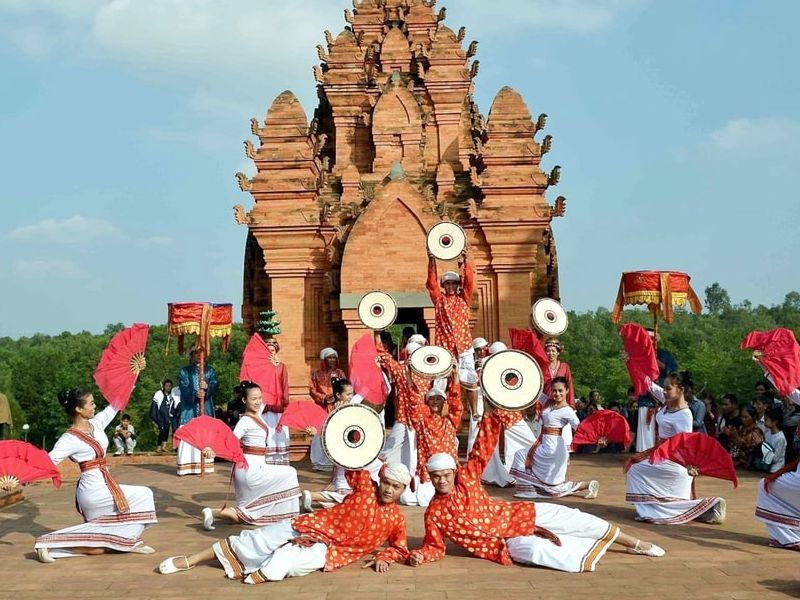
Every seventh month of the Cham calendar, the ancient towers in the Ninh Thuan region come alive with the Kate Festival. The sound of Ginang drums and Saranai horns fills the air, traditional costumes add vibrant colors, and sacred rituals bring the Cham community together. In 2026, the festival takes place from October 5 to 12, with the main celebration on October 10.
A living cultural heritage
The Ninh Thuan region, formerly Ninh Thuan Province and now part of Khanh Hoa Province, is one of Vietnam’s important centers of Cham culture. The region is known for its Cham villages, traditional brocade weaving, Bau Truc pottery and ancient temple towers.
Among its most remarkable landmarks is Po Klong Garai Tower, a complex consisting of the Main Tower, Gate Tower and Fire Tower. Built around the late 13th to 14th centuries, the complex stands on Trau Hill and is one of the most distinctive symbols of Cham architecture in the region.
On ordinary days, its red-brick towers create a quiet and timeless landscape. During Kate, however, the atmosphere changes as Cham communities from surrounding villages gather for religious ceremonies.
For visitors, this is an opportunity to see heritage as something more than an ancient monument. The towers remain living spiritual spaces that continue to play an important role in the cultural life of the Cham community.
Kate 2026: A festival in October
Kate follows the traditional Cham calendar, so its Gregorian date changes each year. In 2026, the festival takes place from October 5 to 12, with the main celebration on October 10, corresponding to the first day of the seventh month in the Cham calendar.
Important ceremonies are associated with sacred sites such as Po Klong Garai Tower, Po Rome Tower and Po Inư Nưgar Temple.
One of the festival’s most distinctive rituals is the procession of sacred costumes belonging to deities and revered kings. Other ceremonies include opening the tower, bathing and dressing sacred statues, making offerings, and performing traditional music and dances.
Travelers wishing to experience the festival can plan their visit between October 5 and 12, 2026, with October 10 being the main ceremonial day.
The colors and sounds of Kate
The appeal of Kate lies not only in its rituals but also in its vibrant cultural atmosphere.
Against the red brick of the ancient towers, traditional Cham costumes create striking colors. The rhythmic sounds of Ginang drums and Saranai horns accompany traditional dances and folk melodies.
Yet Kate is first and foremost a religious festival of the Cham Balamon community, rather than simply a cultural performance for tourists. Ceremonies take place at temples and towers, as well as in villages and family homes, reflecting traditions of honoring deities, revered kings and ancestors.
This is what makes Kate particularly meaningful: visitors are witnessing a cultural heritage that is still being practiced and passed from one generation to the next.
Beyond the towers
A journey during Kate can be combined with exploring other aspects of Cham culture.
Visitors can travel from Po Klong Garai to nearby Cham communities to discover traditional brocade weaving and Bau Truc pottery, one of the best-known traditional crafts of the Cham people.
The wider region also offers vineyards, coastal landscapes, sheep farms and other distinctive scenery along Vietnam’s South Central Coast.
For travelers, a Kate journey can therefore combine cultural heritage, community experiences and scenic exploration.
A respectful way to experience Kate
Because Kate is a religious festival, visitors should approach the celebrations with respect. Modest clothing is recommended, while restricted ritual areas should be avoided. Visitors should not touch sacred objects or disrupt ceremonies.
When photographing people taking part in religious rituals, asking permission whenever possible is also a thoughtful way to engage with the community.
Respectful travel allows visitors to experience Kate more meaningfully while helping preserve the cultural space for the community itself.
When the towers come alive
On ordinary days, Po Klong Garai stands quietly beneath the sun, telling the story of the ancient Champa civilization through its red bricks and distinctive architecture.
But when Kate arrives, the towers seem to come alive.
Drums and horns fill the air, traditional costumes add color, and communities return to the sacred spaces of their ancestors. Past and present meet through rituals that have been passed down for generations.
In 2026, Kate returns to the former Ninh Thuan region from October 5 to 12, with the main celebration on October 10. Today, this historic region is administratively part of Khanh Hoa Province, but its name remains closely associated with the Cham cultural heritage that defines the area.
For travelers, Kate is more than an opportunity to see ancient Cham towers during festival season. It is a chance to understand how a community continues to preserve its memories, identity and beliefs through living traditions.
Some heritage sites are preserved in museums. Others continue to live through the people who celebrate them.