
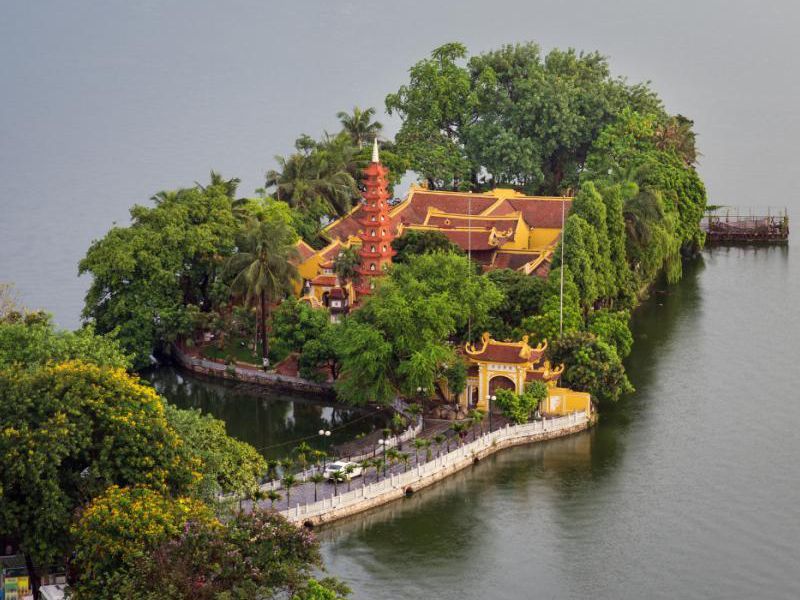
By the quiet waters of West Lake stands Tran Quoc Pagoda, one of Hanoi’s oldest Buddhist sites. For centuries, the pagoda has witnessed the changing landscape of the capital while preserving important traces of Vietnamese Buddhist culture and history.
From Khai Quoc to Tran Quoc
Tran Quoc Pagoda was founded in the 6th century under the reign of King Ly Nam De. Its original name was Khai Quoc, meaning “Founding the Nation.”
The pagoda was first located near the Red River. In 1615, because of riverbank erosion, it was moved to Kim Ngu Hill, its present location on the shore of West Lake.
The name later changed from Khai Quoc to An Quoc and eventually to Tran Quoc. In 1842, Emperor Thieu Tri renamed the pagoda Tran Bac, although the name Tran Quoc continued to be widely used.
Architecture and historical remains
Tran Quoc follows the traditional layout of a Vietnamese Buddhist pagoda, with the Front Hall, Incense-burning Hall, and Upper Sanctuary arranged along a central axis. Behind the main buildings is a stupa garden containing tomb towers of monks from different periods.
The pagoda also preserves many valuable religious and artistic objects, including Buddhist statues, stone inscriptions, and a wooden statue depicting Shakyamuni Buddha entering Nirvana, decorated with traditional lacquer and gilding.
Together, these remains provide valuable evidence of the development of Vietnamese Buddhist art and architecture through different historical periods.
The Luc Do Dai Sen Stupa
One of the pagoda’s most recognizable features is the Luc Do Dai Sen Stupa, built in 1998. The stupa is about 15 metres high and has 11 levels, housing 66 statues of Amitabha Buddha.
Although it is a modern addition, the stupa has become an important part of the visual identity of Tran Quoc Pagoda.
The Bodhi tree
The pagoda is also home to a Bodhi tree planted in 1959. It was presented to President Ho Chi Minh by Indian President Rajendra Prasad during his visit to Vietnam on 29 March 1959.
For Buddhists, the Bodhi tree recalls the tree associated with the Buddha’s enlightenment. At Tran Quoc, it also represents the long-standing cultural and Buddhist connections between Vietnam and India.
A national cultural heritage site
Tran Quoc Pagoda was recognized as a National Historical and Cultural Monument in 1962.
Today, it remains an active Buddhist place of worship as well as an important cultural landmark of Hanoi. Its setting beside West Lake brings together religious life, historical memory, architecture, and the natural landscape of the capital.
One pagoda, many layers of history
Tran Quoc is more than an ancient Buddhist site. Its long history reflects the transformation of Hanoi, the development of Vietnamese Buddhism, the evolution of Buddhist art and architecture, and the cultural connections between Vietnam and the wider Buddhist world.
Following the trail of Vietnamese pagodas is, in many ways, a journey through the history of Vietnam itself. At Tran Quoc, that history remains quietly present—in the old stupas, sacred images, the Bodhi tree, and the waters of West Lake surrounding the pagoda.