
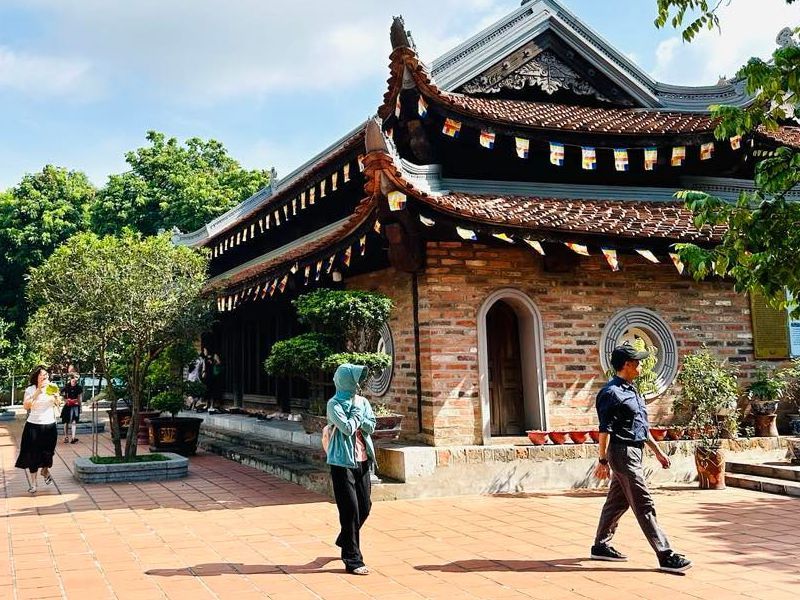
Among the historic pagodas of Thang Long, Kim Lien Pagoda holds a distinctive place in the Nghi Tam area by West Lake. The pagoda is not remarkable for its scale, but for the elegance of its wooden architecture, gently curved roofs, and refined decorative details shaped by different historical periods. With more than three centuries of history under the name Kim Lien, the pagoda has witnessed the transformation of Nghi Tam while preserving important layers of history, architecture, and Buddhist culture.
From the legend of Princess Tu Hoa to Dai Bi Pagoda
The history of Nghi Tam has long been associated with the story of Princess Tu Hoa, daughter of King Ly Than Tong. According to local tradition, she and her attendants came to this area to cultivate mulberry trees and raise silkworms, giving the region an association with sericulture along the shores of West Lake. This story forms an important part of the cultural memory of Nghi Tam, although it should be understood as local tradition rather than as a fully established historical fact.
For the history of the pagoda itself, the stone inscriptions preserved here provide firmer evidence. According to these records, the pagoda was once known as Dai Bi and was established in 1631, during the Later Le period. In 1638, it was expanded with contributions from the local community.
In 1771, under Lord Trinh Sam, the pagoda underwent restoration and was given the name Kim Lien, which it has retained ever since.
Architecture shaped by Thang Long
The present appearance of Kim Lien Pagoda reflects several periods of restoration, including important renovations in the late 18th century, particularly in 1792.
The pagoda follows a traditional layout of three connected buildings arranged along a central axis. Its two-tiered roofs, with gently upturned corners, create a light and graceful silhouette. Among its architectural features, the wooden gateway is particularly distinctive, with balanced proportions and finely carved decorative details.
The architecture of Kim Lien reflects characteristics of Buddhist art from the Le–Trinh and Tay Son periods. The restrained combination of timber, tiled roofs, and decorative carvings gives the pagoda a character of its own, different from the larger Buddhist complexes found elsewhere in Hanoi.
It also remains an important surviving example for understanding the historic Buddhist architecture of the former Thang Long region.
Stone inscriptions and the memory of the pagoda
Alongside its architecture, the collection of stone inscriptions is an important source for studying the history of Kim Lien Pagoda. The surviving stelae record different periods of the pagoda’s development, including its construction, restoration, and the contributions made by the local community.
These inscriptions tell more than the story of a religious site. They also reveal the relationship between the pagoda and the people who lived around it. Records of donations, restoration work, and religious activities show how the pagoda formed part of the cultural life of Nghi Tam and historic Thang Long.
Through these surviving materials, the history of Kim Lien can be approached from two perspectives: the folk memories passed down through generations and the physical evidence that remains today.
A Buddhist sanctuary by West Lake
Nghi Tam has changed considerably from the lakeside landscape of earlier centuries. Former villages have gradually become part of Hanoi’s expanding urban environment, yet Kim Lien Pagoda retains its own sense of place, with its tiled roofs, wooden gateway, Buddhist images, and weathered stone inscriptions.
Its location beside West Lake also makes the pagoda part of a distinctive cultural landscape on the western side of historic Thang Long. Here, the history of the pagoda is inseparable from the history of its surroundings—from stories of Princess Tu Hoa and traditional sericulture to Buddhist life and the transformation of Hanoi over time.
Kim Lien Pagoda was recognized as a National Historical and Cultural Monument on 28 April 1962, acknowledging its importance within Hanoi’s cultural heritage.
A Thang Long landmark by West Lake
While Tran Quoc Pagoda evokes a layer of Buddhist history reaching back to the 6th century, Kim Lien reveals another chapter of Thang Long’s past: the history of a lakeside community, its cultural traditions, and the development of Buddhist architecture over the centuries.
Kim Lien does not need monumental scale to hold a distinctive place in Hanoi’s cultural landscape. Through its wooden gateway, curved roofs, and weathered stone inscriptions, the pagoda continues to tell the story of Nghi Tam—a place where history, faith, and community life gradually shaped the character of Thang Long beside West Lake.