
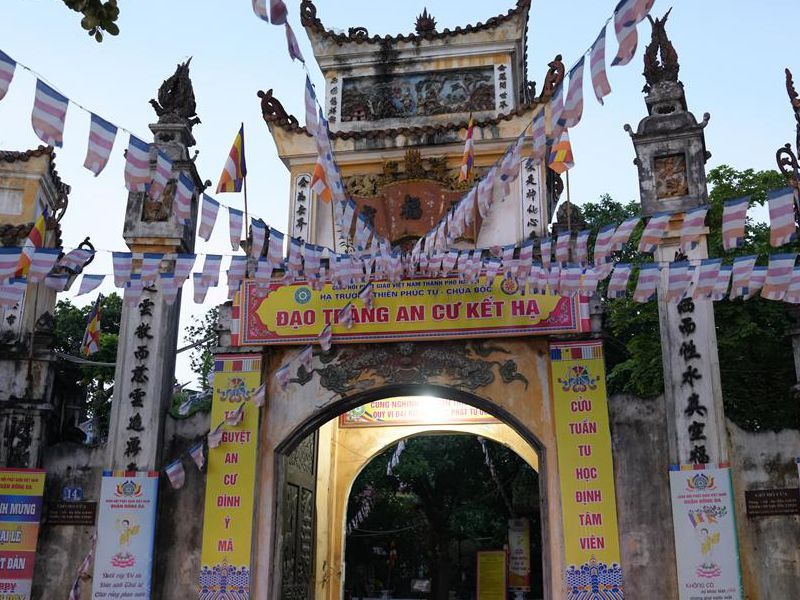
Origins and Historical Development
Boc Pagoda, also known as Sung Phuc Pagoda and later associated with the name Thien Phuc Pagoda, is an important historical and cultural heritage site in Hanoi, Vietnam. Located in the former Khuong Thuong area of Dong Da District, the pagoda is closely associated with the Battle of Dong Da in the spring of 1789, when the Tay Son army, under the command of Emperor Quang Trung (Nguyen Hue), defeated Qing forces.
According to historical records and local heritage sources, the original founding date of the pagoda has not been conclusively established. However, an important milestone in its history was the year 1676, during the reign of Emperor Le Hy Tong, when the pagoda underwent renovation. A stone inscription entitled Trung tu Sung Phuc tu (Renovation of Sung Phuc Pagoda), dated to the first year of the Vinh Tri era (1676), provides valuable evidence of the pagoda’s existence and development. Therefore, 1676 should be regarded as a documented renovation date rather than the confirmed year of its original construction.
A major turning point in the pagoda’s history occurred in 1789, during the Tay Son campaign against the Qing army. The Khuong Thuong area was one of the important battlefields during this campaign. Historical accounts indicate that Sung Phuc Pagoda suffered severe damage during the fighting.
In 1792, during the reign of Emperor Quang Trung, the pagoda was rebuilt on its original site and became associated with the name Thien Phuc Pagoda. A stone inscription entitled Tai tao Sung Phuc tu, Phat tuong cac toa bi ky (Inscription on the Reconstruction of Sung Phuc Pagoda and Its Buddhist Statues), dated to the fourth year of the Quang Trung era (1792), records the reconstruction of the pagoda and the restoration of its Buddhist statues. The inscription mentions the contributions of the Buddhist monk Le Dinh Luong, also known as Duc Truong, the local official Vu Viet Hoa, and members of the local community.
The popular name “Boc Pagoda” is commonly associated with the battlefield of 1789 and stories about the aftermath of the fighting. However, the precise origin of this name should be distinguished from events directly confirmed by historical documents. Nevertheless, the pagoda’s connection with the Battle of Dong Da has become an important part of Hanoi’s historical memory.
Architecture and Historical Artifacts
Boc Pagoda displays characteristic features of traditional Buddhist architecture in northern Vietnam. Its complex includes a three-entrance gate, a front hall, a main sanctuary, ancestral worship areas, corridors, and a garden containing stupas. Although the pagoda has undergone numerous repairs over the centuries, it retains architectural features and artifacts of considerable historical and artistic value.
The stone inscriptions preserved at the pagoda are particularly important for historical research. The inscription dated 1676 documents a period of renovation during the Later Le dynasty. Another inscription, dated 1686, is associated with the casting of Buddhist statues and a bronze bell. Meanwhile, the inscription of 1792 records the reconstruction of the pagoda following the events of 1789.
Together, these inscriptions provide information about the development of the religious complex and acknowledge the contributions of Buddhist monks, local officials, and community members to its preservation. They also offer valuable evidence for studying the history of religious life and community activities in the former Thang Long region.
In addition to the inscriptions, the pagoda preserves Buddhist statues, horizontal lacquered boards, parallel couplets, and other religious artifacts. These objects reflect the development of Vietnamese Buddhist art and religious practices across different historical periods.
The Statue of Duc Ong and Its Association with Emperor Quang Trung
One of the most distinctive features of Boc Pagoda is its statue of Duc Ong, which some heritage researchers have associated with Emperor Quang Trung (Nguyen Hue). The statue’s seated posture and clothing differ from the representations of Duc Ong commonly found in many traditional Vietnamese pagodas.
According to an article published by the Vietnam National Museum of History, an inscription on the back of the statue’s wooden pedestal has been read as “Binh Ngo tao Quang Trung tuong,” meaning that a statue of Quang Trung was created in a Binh Ngo year, corresponding to 1846. This inscription is an important piece of evidence supporting the association between the statue and Emperor Quang Trung.
Some interpretations suggest that the statue may have been worshipped under the title of Duc Ong because of the political circumstances following the end of the Tay Son dynasty. However, the precise circumstances surrounding the statue’s creation, its original purpose, and the reasons for its identification remain questions that require careful consideration.
In academic research, it is important to distinguish between physical evidence, scholarly interpretations, and local legends. The association between the statue and Quang Trung is supported by the reported inscription and the statue’s distinctive characteristics. Nevertheless, not every story about its origins should automatically be treated as an established historical fact.
Historical, Cultural, and Spiritual Significance
The most prominent historical value of Boc Pagoda lies in its close connection with the Battle of Dong Da in 1789. The pagoda preserves memories of a military campaign that occupies an important place in Vietnam’s history of resistance against foreign invasion. Its artifacts and historical records help researchers explore the geographical context of the battlefield, religious life, and the ways in which local communities have remembered historical events.
From a cultural perspective, Boc Pagoda demonstrates the relationship between Buddhism, historical commemoration, and community life. In addition to Buddhist worship, the site is associated with the remembrance of Emperor Quang Trung and those who lost their lives in the conflict. Commemorative activities held around the fifth day of the first lunar month reflect the community’s respect for history and its desire to preserve collective memories.
Boc Pagoda also possesses considerable architectural and artistic value. Its Buddhist statues, stone inscriptions, horizontal lacquered boards, and parallel couplets provide useful materials for studying Vietnamese Buddhist art, traditional architecture, and local history.
On January 13, 1964, Boc Pagoda was recognized as a national historical site in Vietnam. This recognition highlights the importance of protecting its architecture, artifacts, inscriptions, and associated cultural traditions.
Conclusion
Boc Pagoda is an important historical and cultural heritage site in Hanoi. The documented renovation in 1676, the damage associated with the conflict of 1789, and the reconstruction in 1792 illustrate the pagoda’s close relationship with Vietnam’s historical development and local community life.
Its traditional architecture, stone inscriptions, and religious statues provide valuable evidence for understanding both the history of the site and the ways in which Vietnamese communities preserve historical memory through religious spaces. Studying and conserving Boc Pagoda therefore contributes to the protection of cultural heritage, the promotion of historical understanding, and the transmission of national traditions to future generations.