
Origins and historical background
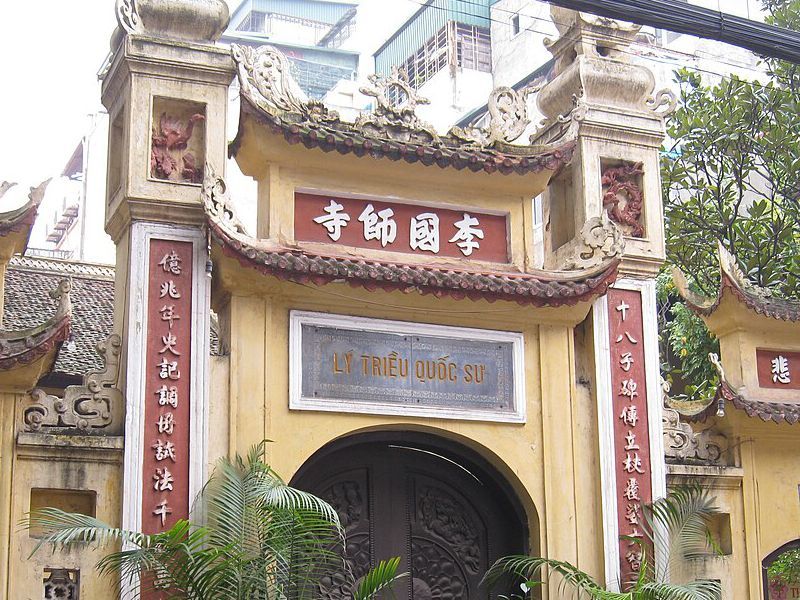
Ly Trieu Quoc Su Pagoda, commonly known as Ly Quoc Su Pagoda, is located at No. 50 Ly Quoc Su Street, Hang Trong Ward, in the former Hoan Kiem District of Hanoi, Vietnam. The pagoda is a historic religious site closely associated with Buddhist monk Nguyen Minh Khong and the development of Buddhism during the Ly Dynasty. In addition to serving as a place of Buddhist worship, the pagoda commemorates National Preceptor Minh Khong and preserves historical traces and artifacts that contribute to the study of the cultural heritage of ancient Thang Long.
Nguyen Minh Khong, whose secular name was Nguyen Chi Thanh, lived from 1066 to 1141 and was a prominent figure in Vietnamese Buddhism during the medieval period. According to historical accounts and folk traditions, he was deeply knowledgeable about Buddhist teachings and was widely respected among Buddhist monks. He is also associated with the story of treating Emperor Ly Than Tong. Following this event, he received royal recognition and was conferred the title of Quoc Su, meaning National Preceptor. The name Ly Trieu Quoc Su reflects his close association with the Ly Dynasty.
According to accounts introducing the historical site, the origins of the place of worship are associated with the year 1131, during the reign of Emperor Ly Than Tong. However, this historical date should be distinguished from the establishment of the original shrine and the construction of the surviving architectural structures, as the site underwent numerous renovations and reconstructions over subsequent centuries.
According to local tradition, the place of worship was once associated with Tien Thi Village in the ancient imperial capital of Thang Long, near the famous Bao Thien Tower. As a result of historical changes and urban development, the place of worship eventually became established at its present location. Further research into the relocation of the site requires comparison with historical inscriptions and specialized scholarly sources.
Renovations and the development of the pagoda
Throughout its history, the site has undergone several renovations, reflecting the efforts of local authorities and the community to preserve the place dedicated to National Preceptor Minh Khong. These restoration projects helped maintain the structure and contributed to the architectural appearance and collection of artifacts that can be found at the pagoda today.
One notable milestone occurred in 1674, during the Later Le Dynasty, when the site underwent renovation. Several worship statues associated with Buddhist monks and other revered figures are regarded as valuable examples of historical heritage and religious sculpture. These artifacts provide insights into the development of religious practices and artistic traditions during this period.
In 1855, during the Nguyen Dynasty, the shrine underwent a major restoration organized by a district official surnamed Phan, who served in Tho Xuong District. The complex was expanded to include a front worship hall, a rear sanctuary, two side galleries, and a three-entrance gate at the front. The statues were also repaired, repainted, and supplemented with additional figures. This restoration illustrates the role of local officials, families, and residents in maintaining the religious site.
An especially important historical source is the inscription titled Trung Tu Tien Thi Tu Ky, composed in 1855 during the reign of Emperor Tu Duc. The inscription records information about the history and restoration of the shrine, including contributions made by individuals and the local community. It is also a valuable source for studying urban history and religious practices in Thang Long–Hanoi.
In 1932, according to accounts of the site, Buddhist worship was introduced into the place of worship. From that time onward, the complex gradually became widely known as Ly Quoc Su Pagoda. This development reflects the evolution of the religious space, where the commemoration of a historical figure came to coexist with Buddhist worship.
During the fighting in 1946, the structure suffered severe damage. The pagoda was restored in 1954, followed by another major renovation in 2000 to preserve and improve its architectural features. Its present appearance is therefore the result of several periods of construction, repair, and restoration rather than an entirely intact structure dating from the Ly Dynasty.
Architecture and notable artifacts
Ly Trieu Quoc Su Pagoda displays characteristic features of traditional Buddhist architecture in northern Vietnam. Its relatively enclosed grounds contain structures dedicated to Buddhist worship, the commemoration of National Preceptor Minh Khong, and the veneration of related figures. Architectural elements such as the entrance gate, front hall, rear sanctuary, and supporting buildings form a solemn complex suited to its religious and commemorative functions.
The current architectural layout reflects several periods of construction and renovation. Therefore, the site should be studied by examining its surviving structures alongside historical records and other evidence, rather than assuming that the entire complex retains its original Ly Dynasty form.
One of the pagoda’s most notable features is its collection of religious statues. Figures associated with National Preceptor Minh Khong and other revered Buddhist monks reflect the Vietnamese tradition of honoring distinguished religious figures. Some stone statues are considered valuable examples of traditional sculpture and provide material for studying the development of religious art during different historical periods.
Wooden statues and other religious figures repaired or added during later restoration projects also demonstrate the development of artistic techniques and worship practices within the community. Beyond their religious significance, these artifacts offer insights into the relationships among local residents, officials, and religious institutions in preserving the site.
In addition to the statues, the pagoda preserves historical inscriptions and traditional ceremonial objects. The inscriptions document construction, restoration, and contributions made by individuals to the site. When examined alongside architectural evidence and research into urban history, these materials help reconstruct aspects of cultural life in Thang Long–Hanoi over several centuries.
Overall, the architecture, statues, and inscriptions at Ly Trieu Quoc Su Pagoda constitute a valuable collection of historical materials for studying Vietnamese Buddhism, traditional sculpture, and religious life in Hanoi.
Historical, cultural, and spiritual significance
First, Ly Trieu Quoc Su Pagoda holds historical significance because of its association with Nguyen Minh Khong and the Ly Dynasty. The site preserves the memory of an influential figure in Vietnamese Buddhist history while reflecting the role of Buddhism in the political, cultural, and spiritual life of medieval Dai Viet.
Culturally, the pagoda demonstrates the interaction between Buddhist practices and the tradition of commemorating figures respected by the community. The presence of worship dedicated to National Preceptor Minh Khong alongside Buddhist statues illustrates the coexistence of Buddhist devotion and the veneration of eminent monks. The evolution of the site also reflects changes in religious practices over time.
From an artistic perspective, the stone and wooden statues, historical inscriptions, and architectural elements provide valuable material for the study of traditional Vietnamese art. Artifacts from different periods help researchers identify continuities and changes in religious sculpture while demonstrating the artistic skills of Vietnamese craftspeople across the centuries.
Today, the pagoda continues to serve as a place for Buddhist activities, prayer, and religious observance. Located in Hanoi’s historic central area, near Hoan Kiem Lake and the Old Quarter, it contributes to the city’s diverse cultural landscape, where Buddhist monuments coexist with other religious buildings and historic urban structures.
On January 16, 1995, Ly Trieu Quoc Su Pagoda was recognized as a national historical-cultural and architectural-artistic heritage site. This recognition highlights the site’s cultural value and underscores the importance of preserving its architecture, artifacts, and associated cultural traditions.
The heritage value and significance of the site
Ly Trieu Quoc Su Pagoda is a notable historical site that reflects the relationship between history, Buddhism, and the cultural life of Thang Long–Hanoi. Associated with National Preceptor Nguyen Minh Khong and the Buddhist tradition of the Ly Dynasty, the pagoda preserves traces of religious history and the development of the city over many centuries.
The inscriptions, worship statues, and architectural structures are valuable sources for research into history, sculpture, and Vietnamese religious traditions. The restoration projects carried out over different periods also demonstrate the community’s role in maintaining and preserving its religious spaces and cultural heritage.
Today, Ly Trieu Quoc Su Pagoda remains both an active place of Buddhist worship and an important site for understanding Hanoi’s history and culture. Preserving, researching, and promoting its heritage value helps safeguard tangible and intangible cultural heritage while raising public awareness of the capital’s historical and cultural traditions.