
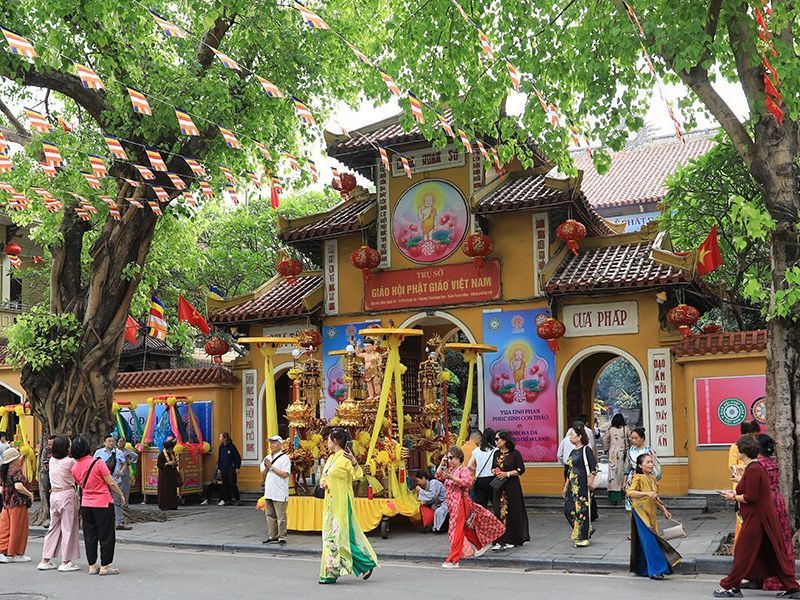
Quan Su Pagoda is one of the most famous Buddhist temples in Hanoi and holds a particularly important place in the religious life of Vietnamese Buddhism. Located at 73 Quan Su Street in the heart of Hanoi, the pagoda combines the solemn atmosphere of a Buddhist sanctuary with a history closely connected to major developments in Vietnamese Buddhism over the centuries.
More than simply a place where local residents and Buddhists come to worship, Quan Su Pagoda is also the headquarters of the Vietnam Buddhist Sangha. Throughout modern history, the pagoda has hosted numerous important events, contributing to the connection and development of Buddhist activities throughout Vietnam.
The Origins of the Name “Quan Su”
The history of Quan Su Pagoda dates back to around the 15th century and is closely associated with diplomatic activities in the ancient capital of Thang Long.
According to historical records, the area once belonged to An Tap Hamlet, Co Vu Ward, Tho Xuong District. At that time, there was no large pagoda here, but only a few thatched structures used by local people for rituals and prayers.
During the reign of King Le The Tong, envoys from countries such as Champa and Ai Lao frequently traveled to Thang Long. The royal court built a guest house known as Quan Su to receive foreign diplomatic missions. Since many of these envoys were Buddhists, the court also established a Buddhist temple within the compound so that they could worship and practice their faith.
Over time, the original Quan Su guest house disappeared, but the pagoda remained. The name Quan Su Pagoda has continued to be used to this day.
This unusual origin makes Quan Su Pagoda a distinctive religious site in Hanoi’s history, as its establishment was directly connected to diplomatic activities and the reception of foreign envoys in the ancient capital of Thang Long.
Changes Throughout History
Throughout its existence, Quan Su Pagoda has undergone numerous changes and renovations.
A stone stele erected in the 19th century records some aspects of the pagoda’s history. During the early Nguyen Dynasty, the surrounding area was associated with military posts. In 1822, the pagoda was renovated to serve the religious needs of soldiers stationed in the area. After the military presence was withdrawn, the pagoda was returned to the local community. The monk Thanh Phuong later continued to renovate the site, adding corridors, restoring statues, and casting a bronze bell.
Entering the 20th century, Quan Su Pagoda increasingly took on an important role in the development of Vietnamese Buddhism.
In 1934, the General Association of Northern Vietnamese Buddhism was established, and Quan Su Pagoda was selected as its headquarters. This marked an important turning point, transforming the pagoda from a long-established place of worship into one of the major centers of Buddhist activities in northern Vietnam.
The Present Appearance of Quan Su Pagoda
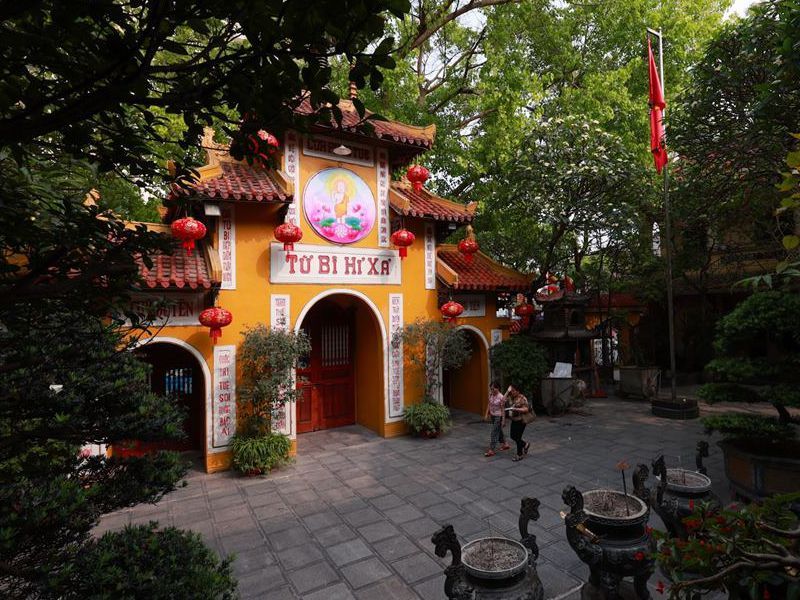
In 1942, the pagoda was rebuilt according to designs by architects Nguyen Ngoc Ngoan and Nguyen Xuan Tung, under the supervision of the Venerable Vinh Nghiem. The new complex combined traditional features of major Buddhist temples in northern Vietnam with the requirements of a modern Buddhist center.
Unlike many ancient pagodas located in rural areas or on the outskirts of the city, Quan Su Pagoda stands in the very heart of Hanoi. Yet once visitors pass through its gates, they can still experience the quiet and solemn atmosphere characteristic of a Buddhist sanctuary.
One distinctive feature of the pagoda is that its name and many of its parallel inscriptions are written in the Vietnamese national script (Quoc Ngu) rather than traditional Chinese characters, as commonly seen at many Vietnamese pagodas. This is a notable characteristic associated with the pagoda’s reconstruction in the mid-20th century.
The Worship Hall and Buddhist Heritage
Quan Su Pagoda houses numerous Buddha and Bodhisattva statues following the traditions of Mahayana Buddhism.
The worship space includes statues of the Three Buddhas of the Past, Present, and Future, Amitabha Buddha, Avalokiteshvara Bodhisattva, Mahasthamaprapta Bodhisattva, and various Buddhist patriarchs. The pagoda also has an altar dedicated to Zen Master Nguyen Minh Khong, a renowned Buddhist monk who lived during the Ly Dynasty.
The statues, ritual objects, and architectural features together create the solemn atmosphere of the pagoda. For generations of Hanoi residents, Quan Su Pagoda has been a familiar destination for Buddhist worship, particularly during major Buddhist festivals and religious occasions.
Quan Su Pagoda and the History of Modern Vietnamese Buddhism
Perhaps the most significant aspect of Quan Su Pagoda is its role in the history of Vietnamese Buddhism during the 20th century.
Beginning in 1934, the pagoda became the headquarters of the General Association of Northern Vietnamese Buddhism. It subsequently hosted numerous important activities related to the organization and development of Buddhism in Vietnam.
In 1952, Quan Su Pagoda hosted the congress that established the Vietnamese National Sangha, attended by Buddhist dignitaries from all three regions of the country. This was an important event in the organizational development of Vietnamese Buddhism during the modern period.
Quan Su Pagoda is also associated with the introduction of the Buddhist flag of the World Fellowship of Buddhists in Hanoi in 1951. The event marked an important step in strengthening connections between Vietnamese Buddhism and the wider international Buddhist community.
Headquarters of the Vietnam Buddhist Sangha
In 1981, the Vietnam Buddhist Sangha was officially established. Quan Su Pagoda was selected as the Central Headquarters of the Vietnam Buddhist Sangha, further affirming its special position in Vietnamese Buddhist life.
Since then, the pagoda has served not only as a place of worship but also as a venue for Buddhist activities, conferences, and important events organized by the Vietnam Buddhist Sangha.
The Institute for Buddhist Studies and various Buddhist organizations have also conducted activities here, making the pagoda an important center for Buddhist research, education, propagation, and development in Vietnam.
Quan Su Pagoda in the Heart of Hanoi
Today, Quan Su Street is located in one of the central areas of Hanoi. The surrounding neighborhood is characterized by busy streets, shops, restaurants, and modern urban buildings.
Yet inside the pagoda grounds, the atmosphere is completely different. The sound of the bell, the scent of incense, and the peaceful worship spaces create a contemplative environment where visitors can temporarily step away from the noise and pace of city life.
This contrast is one of the distinctive charms of Quan Su Pagoda. It is a place where the past and present coexist: an ancient Buddhist temple with roots in the history of Thang Long, while also serving as a center of modern Vietnamese Buddhism.
A Living Heritage of Hanoi
Quan Su Pagoda is remembered not only for its age or architecture. Its greater significance lies in its long history with Thang Long–Hanoi and, particularly, its role in the development of Vietnamese Buddhism.
From a Buddhist temple established within a royal guest house to serve the religious needs of foreign envoys, Quan Su Pagoda has evolved over centuries into one of the most important Buddhist centers in Vietnam.
Today, in the heart of modern Hanoi, Quan Su Pagoda continues to hold a special place in the spiritual life of local residents and Buddhists. A visit here is therefore more than a journey to a peaceful religious sanctuary; it is also an opportunity to discover an important part of the history of Thang Long–Hanoi and the development of Vietnamese Buddhism.