
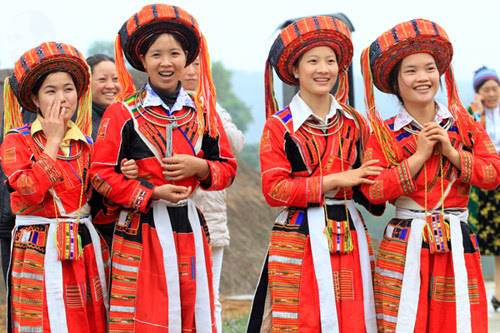
The Pà Thẻn, also known as Pá Hưng, are one of Vietnam’s smaller ethnic communities, living mainly in the northern provinces of Hà Giang and Tuyên Quang. Their language belongs to the Hmong-Mien language family.
With a population of just over 8,000, the Pà Thẻn have preserved a distinctive cultural identity shaped by mountain life, traditional farming practices, ancestor worship, and a rich spiritual world.
From Swidden Fields to Wet-Rice Farming
In the past, the Pà Thẻn primarily practiced swidden agriculture, growing rice, maize, cassava, sesame, taro, vegetables, beans, and a variety of herbs and spices.
Beginning in the 1970s, many Pà Thẻn communities gradually shifted toward wet-rice cultivation. By the 1990s, traditional swidden farming had largely disappeared.
Today, rice remains an important crop, with both glutinous and non-glutinous varieties being cultivated. Alongside farming, Pà Thẻn families traditionally raise buffalo, cattle, pigs, chickens, ducks, goats, and dogs, creating a way of life closely connected to the land and natural environment.
A World Shaped by Gods and Spirits
In traditional Pà Thẻn beliefs, the universe is divided into four realms: the sky, the earth, the waters, and the world below.
The sky is governed by Quơ Vo, while the earth and waters are associated with the goddess Me Quơ O. The world below is inhabited by Me Quơ Lê and numerous spirits.
The Pà Thẻn believe that gods and spirits are present throughout the natural world—in forests, rocks, plants, rivers, streams, and villages. Ancestors, the kitchen god, and protective spirits can bring health, good harvests, and peace, but may also cause illness or crop failure if they are offended.
For this reason, different gods and spirits are honored through their own rituals and offerings, which may include rice, meat, chickens, rice wine, incense, traditional paper offerings, and local cakes.
The Tradition of Ancestor Worship
Ancestor worship holds an important place in Pà Thẻn spiritual life. Many families maintain two ancestral altars, where rituals are performed on important occasions throughout the year.
Ceremonies may take place according to the traditional lunar calendar, as well as during a child’s naming ceremony, when a new house is built or occupied, and during funerals.
Through these rituals, the Pà Thẻn maintain a spiritual connection between generations while passing traditional values and beliefs from parents to children.
The Fire Dancing Festival
One of the most distinctive cultural traditions of the Pà Thẻn is the Fire Dancing Festival, usually held from the end of the tenth lunar month to the middle of the first lunar month.
During the ceremony, a ritual master plays the tầy nhậy, a traditional wooden musical instrument, while performing rituals to call upon gods and spirits. Participants gradually enter a state of trance before stepping barefoot onto glowing embers.
They may jump, walk, or move across the burning coals without showing fear. For the Pà Thẻn, this is far more than a spectacle. It is a sacred ritual through which people connect with the spiritual world and pray for protection, health, peace, and prosperity in the coming year.
As the flames illuminate the night, the festival also becomes an opportunity for the community to gather, share joy, and strengthen social bonds. Fire Dancing is therefore both a spiritual practice and a living cultural memory passed down through generations.
Keeping a Distinctive Culture Alive
Modernization has brought significant changes to Pà Thẻn communities. Yet traditional beliefs, ancestor-worship rituals, agricultural practices, and the Fire Dancing Festival continue to hold an important place in community life.
Although the Pà Thẻn are one of Vietnam’s smaller ethnic groups, they possess a rich cultural heritage that reflects a profound relationship between people, nature, and the spiritual world.
Above all, the image of Pà Thẻn men dancing across glowing embers remains their most powerful cultural symbol—a moment when faith, courage, and community strength come together around the sacred fire. That fire does not burn for just one night. It continues to be passed from one generation to the next, carrying with it the stories, beliefs, and cultural identity of the Pà Thẻn people.