
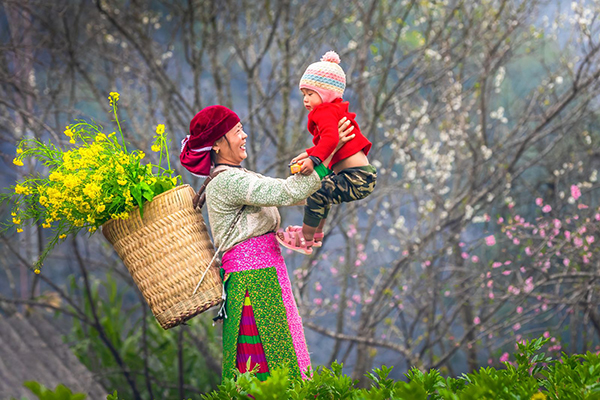
Across the mountains of Southeast Asia, the Hmong have built communities shaped by migration, resilience, and a strong sense of cultural identity. Today, they live mainly in southwestern China and mainland Southeast Asia, including Vietnam, Laos, Thailand, and Myanmar, with large diaspora communities in countries such as the United States and Australia.
In China, the Hmong are officially classified as part of the Miao ethnic group. Outside China, however, many communities identify themselves as Hmong, a name that has become an important part of their modern identity.
From Southern China to Southeast Asia
The origins of the Hmong remain a subject of historical and linguistic research. Hmong traditions contain stories of ancient homelands in northern China, while linguistic and genetic evidence points more broadly to southern China as the ancestral homeland of Hmong-Mien-speaking peoples.
The region between the Yangtze and Mekong river systems is considered one of the most likely areas where early Hmong-Mien communities lived. Over centuries, groups speaking Hmong-Mien languages gradually moved southward. Significant migrations into mainland Southeast Asia took place from around the seventeenth century onward.
Rather than following a single route, Hmong communities migrated in different waves, settling in mountainous areas where they developed new relationships with the land and neighboring peoples.
The Hmong in Vietnam
Hmong communities began moving into northern Vietnam in significant numbers during the nineteenth century. Many settled in the high mountains of what are now Hà Giang, Lào Cai, Lai Châu, Điện Biên, Sơn La, and other northern provinces.
Life in the mountains encouraged the development of distinctive farming practices and close-knit communities. Hmong villages adapted to steep terrain through terraced fields, upland cultivation, livestock raising, and the use of forest resources.
Their arrival also brought them into contact with other ethnic groups, including the Tai-speaking peoples and communities already living across the northern highlands. Over time, these interactions became part of the complex cultural landscape of northern Vietnam.
A History Shaped by Conflict and Migration
The nineteenth and twentieth centuries brought major political changes to the regions where the Hmong lived. Conflicts in southern China pushed waves of migrants toward Southeast Asia, while colonial rule and later wars transformed mountain communities.
During the French colonial period in Vietnam, Hmong communities followed different political paths. Some supported Vietnamese nationalist and revolutionary movements, while others, particularly Christianized communities, allied with the French.
The upheavals of the First Indochina War and later the Vietnam War created further divisions and displacement. These experiences would eventually lead to one of the largest Hmong migrations in modern history.
From Laos to a New Life in America
After the Vietnam War, thousands of Hmong refugees left Laos and neighboring countries, many passing through refugee camps in Thailand before being resettled abroad.
The United States became one of the principal destinations. The first significant groups arrived in the mid-1970s, followed by larger waves after the Refugee Act of 1980 made it possible for more families to reunite and settle in America.
Hmong families eventually established communities across the United States. Some of the largest developed in California, Minnesota, Wisconsin, Washington, and Oregon, while smaller communities emerged in states including Massachusetts, Michigan, Montana, and Alaska.
Migration changed Hmong life, but it did not erase cultural identity. Instead, communities developed new ways to preserve language, family traditions, ceremonies, clothing, music, and stories while adapting to life in a new country.
Culture Woven Through Clothing and Community
Hmong culture is diverse, with different groups maintaining their own languages, customs, clothing styles, and traditions. Among the largest cultural divisions are the Hmong Der, often associated with the White Hmong, and the Hmong Leng, commonly associated with Blue or Green Hmong communities.
Traditional women’s clothing is one of the most recognizable expressions of this diversity. Colors, embroidery, batik patterns, silver ornaments, and textile designs can reflect community identity and local traditions.
Textile work is more than decoration. Embroidery and batik preserve stories, symbols, family knowledge, and artistic skills passed from one generation to another. Traditional clothing therefore becomes a form of cultural memory that can be carried wherever Hmong people travel.
A Culture That Continues to Evolve
Despite centuries of migration and profound political change, the Hmong have maintained a strong sense of identity. Their languages, clan structures, oral traditions, textiles, music, agricultural knowledge, and spiritual practices continue to connect generations.
For Hmong communities in Vietnam, Southeast Asia, China, and the global diaspora, cultural identity is not simply a reminder of the past. It is something continuously recreated in everyday life.
From the misty mountains of northern Vietnam to communities thousands of kilometers away, the Hmong story is ultimately one of movement and belonging—a history shaped by migration, but sustained by the determination to preserve a culture across generations.