
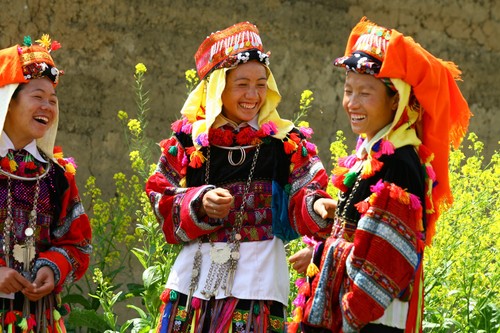
Across the mountains of southern China and northern Vietnam, Yao culture has been shaped by rice fields, hillside villages, and traditions centered on ancestors. Known as Yao in China and Dao in Vietnam, the Yao are a diverse community with a long history of migration and cultural exchange. Despite these changes, they have preserved distinctive customs, spiritual beliefs, and ways of life that remain closely connected to the land and their ancestral heritage.
Today, Yao communities are found mainly in the mountainous regions of southern and southwestern China and northern Vietnam, as well as in Laos, Thailand, and the United States. Their cultural identity continues to live through agriculture, traditional clothing, religious practices, and festivals that bring families and communities together.
From Southern China to Southeast Asia
Yao traditions trace their history back more than two thousand years to the region around Dongting Lake in present-day Hunan. One of their best-known origin stories tells of Pan Hu, a faithful dog who saved Emperor Gao Xin from an enemy leader. As a reward, Pan Hu was transformed into a man and married the emperor’s daughter. Their descendants are traditionally regarded as the ancestors of the Yao people.
Between roughly 200 BCE and 900 CE, Yao communities gradually moved southward from the Yangtze region, settling in mountainous areas across southern China. Later conflicts and political changes encouraged further migration toward Guangxi, Guangdong, Yunnan, and eventually mainland Southeast Asia.
Their history was therefore shaped not only by the mountains where they settled, but also by repeated journeys across changing political and cultural landscapes.
A Life Built Around Farming
Agriculture has long been at the heart of Yao life. For more than a thousand years, many Yao communities have cultivated rice, adapting plowing and farming techniques to mountainous terrain. Some groups also practiced shifting cultivation, while those living near forests supplemented their livelihoods through hunting and gathering.
Farming was more than a way to produce food. The agricultural calendar influenced community life, seasonal rituals, and traditional celebrations. The harvest season, in particular, was a time to give thanks for the year’s crops, honor ancestors, and pray for prosperity in the coming year.
Traditional clothing also became an important expression of Yao identity. Historical records describe Yao people wearing distinctive blue garments made with indigo dye. Across different communities, weaving, embroidery, and textile decoration have continued to preserve local artistic traditions and cultural identity.
Family, Ancestors, and Community
Traditional Yao society has generally followed a patrilineal system, with family lines and inheritance passing through the male side. Sons traditionally inherited from their fathers, while married couples commonly lived with or near the husband’s family.
The family is also closely connected to ancestor worship. Ancestors are not regarded simply as figures from the distant past but as an enduring presence in the spiritual world. They are honored through household rituals, offerings, and important community festivals.
This connection between family and ancestors has helped preserve cultural knowledge across generations, even as Yao communities have experienced significant social and economic changes.
A Spiritual World of Gods and Rituals
Yao religious traditions bring together ancestor worship, local folk beliefs, shamanic practices, and strong historical influences from Taoism.
Traditional ritual specialists played an important role in community life. They performed ceremonies for protection, communicated with spirits, conducted exorcisms, and practiced forms of divination using objects such as chicken bones or bamboo sticks.
Over time, Taoist teachings and rituals became deeply integrated into Yao religious traditions. At the same time, older beliefs in spirits and supernatural forces continued to survive. The result is a complex spiritual world shaped by different layers of history and cultural exchange.
Pan Wang: A Festival of Ancestors and Harvest
One of the most important celebrations in Yao culture is the Pan Wang Festival, held annually on the sixteenth day of the tenth lunar month.
The festival is closely associated with the traditional story of Pan Hu, regarded in Yao mythology as an ancestral figure. Over time, the celebration has also become an occasion to give thanks for a successful harvest, honor ancestors, and bring the community together.
Traditional music, clothing, ritual ceremonies, food, and communal gatherings are important parts of the celebration. Through the festival, stories about the origins of the Yao are not simply remembered—they are passed on through living cultural practices.
A History of Migration
The twentieth century brought another period of upheaval. In Laos, some Yao communities became involved with U.S.-supported forces during the Laotian Civil War. After the communist victory, many faced political pressure and displacement, prompting further migration into Thailand.
From refugee camps along the Thai-Laotian border, some Yao families eventually resettled in the United States with international assistance. Many established communities in California, Oregon, and Washington.
Migration once again transformed Yao life, but communities abroad continued to maintain family traditions, cultural celebrations, and connections with their heritage.
A Heritage That Continues to Live
Today, the Yao are a diverse collection of communities spread across several countries. Their languages, clothing, agricultural knowledge, religious traditions, ancestor worship, and festivals reflect a long history of migration and cultural exchange.
Yet beneath this diversity is a strong connection to family, ancestors, land, and community.
From mountain rice fields to the celebrations of Pan Wang, Yao culture continues to evolve while preserving memories of the past. The harvest is not only a season of abundance—it is also a moment to remember those who came before, give thanks for what the land provides, and pass cultural traditions on to the next generation.