
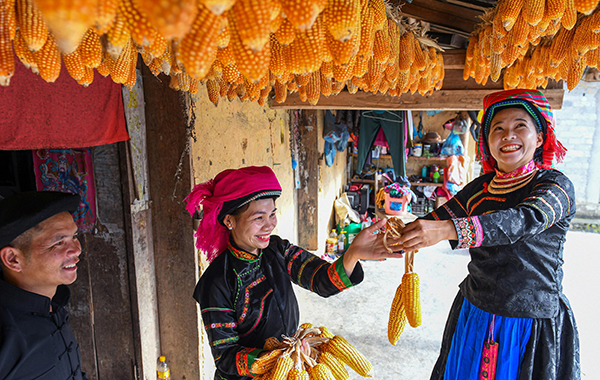
The Pu Péo, also known as the Qabiao, are one of Vietnam’s smallest ethnic communities. They live mainly in Hà Giang Province in northern Vietnam, with a smaller population residing in Malipo County, Yunnan Province, China. Having lived for generations along the Vietnam–China border, the Pu Péo have developed a distinctive cultural identity reflected in their traditional clothing, spiritual beliefs, ancestral customs, and deep connection with nature.
According to Vietnam’s 2019 census, there were around 903 Pu Péo people in the country. In China, the Qabiao are classified as part of the Yi ethnic group. Their autonym is qa˧ biau˧, while they are also known in China as “Bendi Lolo,” meaning “indigenous Lolo.”
A Community Living Along the Vietnam–China Border
The Pu Péo have historically inhabited both sides of the Vietnam–China border. However, they have never formed a large population and have traditionally lived in relatively small communities.
In China, the Qabiao are mainly concentrated near the Vietnamese border in Malipo County, Yunnan Province. Several villages associated with the community include Tiechang, Matong, Punong, Pucha, and Pufeng.
In Vietnam, the Pu Péo primarily live in Hà Giang Province, particularly in several communes of Đồng Văn District. Their traditional way of life has developed in the rugged mountainous environment of the northern highlands, where people have long depended on and adapted to their natural surroundings.
Traditional Clothing with Colorful Details
Traditional clothing is one of the most recognizable features of Pu Péo culture. In the past, Pu Péo women typically wore ankle-length skirts together with two layers of vests.
Today, traditional dress has gradually changed, and it has become increasingly common for women to wear only the inner vest, known as Bok tam. This garment is made from five panels and features buttons fastened beneath the right armpit.
One of the most distinctive features of Pu Péo clothing is the use of colorful strips of fabric sewn along the hems, neckline, and sleeves. These vibrant details add elegance and character to the garments while demonstrating the careful craftsmanship of Pu Péo women.
Some decorative elements of their clothing also bear similarities to those found in the traditional costumes of the Giay people, reflecting the cultural interaction that has taken place among ethnic communities living in northern Vietnam.
Spiritual Beliefs Centered on Souls and Ancestors
The spiritual life of the Pu Péo is strongly influenced by animistic beliefs. Traditionally, souls and spirits are considered important forces that influence human life and the natural world.
The Pu Péo believe that each person possesses eight souls and nine spirits, which are thought to influence an individual’s actions and existence.
Many Pu Péo households have a small ancestral altar where family members honor their ancestors. Three sandstone jars are traditionally placed on the altar, with each jar representing a generation of ancestors.
Other symbolic objects may also be found in the household, including dried pumpkins and bundles of ox-tail hair attached to sticks. According to traditional beliefs, these objects serve as signs that help deceased ancestors recognize their descendants.
A Sacred Forest and a Commitment to Nature
Another remarkable aspect of Pu Péo culture is their respect for the sacred forest.
For the Pu Péo, forests are more than sources of natural resources. They also have profound spiritual and cultural significance. The community maintains an oath to protect its sacred forest, reflecting a deep respect for nature and the belief that human beings are closely connected with the natural world.
This tradition has helped strengthen a sense of communal responsibility toward protecting the environment and preserving forests that hold special spiritual meaning.
Preserving the Heritage of a Small Ethnic Community
As one of Vietnam’s smallest ethnic groups, the Pu Péo face challenges in maintaining their traditional cultural heritage in the modern world.
Their clothing, spiritual practices, ancestral traditions, and beliefs about sacred forests all reflect a long history of settlement in the mountainous borderlands of Vietnam and China.
As lifestyles continue to change, preserving the Pu Péo language, traditional clothing, customs, spiritual practices, and community traditions is increasingly important. These cultural treasures are valuable not only to the Pu Péo themselves but also to Vietnam’s rich and diverse national heritage.
Although small in population, the Pu Péo possess a remarkable cultural identity. Their traditions, passed down through generations, form an important part of the cultural landscape of Hà Giang and contribute to the unique heritage of the ethnic communities living along the Vietnam–China border.