
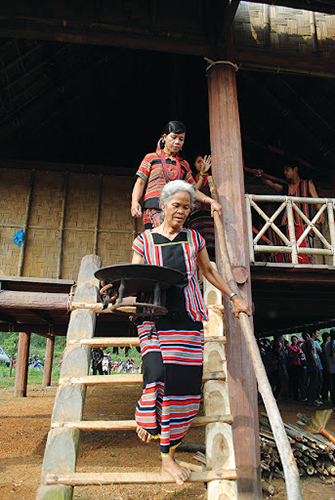
The Brau people are an ethnic group living in Laos, Cambodia, and Vietnam. In Vietnam, most Brau people live in Đắc Mế Village, Bờ Y Commune, Ngọc Hồi District, Kon Tum Province. With a population of just 525 in 2019, they are one of Vietnam’s smallest ethnic communities. Their ancestors migrated from southern Laos and northeastern Cambodia to Vietnam around 150 years ago, and they speak Brao, a Mon–Khmer language.
Brau culture is deeply connected to nature, traditional beliefs, and oral traditions. Their legend Un cha đắc lếp tells the story of the Great Flood, while Pa Xây is regarded as the Creator God. Music also holds an important place in community life, with distinctive instruments such as Táp đinh bố, a type of K’lông pút, and Tha, a traditional gong.
The Brau are also known for distinctive traditional customs, including uốt bưng (tooth filing), síp tiêu (ear stretching), and chingkrackang (forehead tattooing). Traditionally, Brau people used only two family names: Thao for men and Nang for women.
Their close relationship with the natural world is also reflected in traditional hunting practices and elephant training. The capture, domestication, and training of elephants, known as Ruhe in the Brao language, form part of the community’s cultural heritage.
For travelers exploring Kon Tum and Vietnam’s Central Highlands, discovering Brau culture offers a glimpse into the traditions of one of Vietnam’s smallest ethnic communities, where legends, music, customs, and a deep connection with nature continue to shape their cultural identity.