
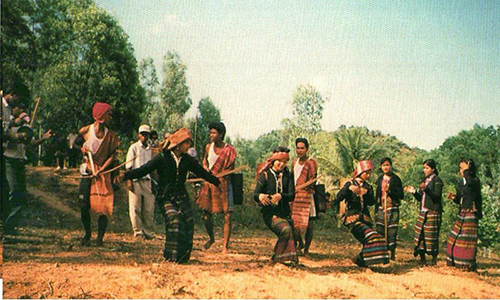
The Bru–Vân Kiều are an indigenous ethnic group living across Vietnam, Laos, and Thailand. They speak Bru, a Katuic language belonging to the Mon–Khmer family. In Vietnam, they mainly live in the mountainous areas of Quảng Bình, Quảng Trị, and Thừa Thiên–Huế, with Vân Kiều, Trì, Khùa, and Ma Coong among the main local groups.
Traditionally, Bru–Vân Kiều communities settled near waterways, building stilt houses around a central communal space. Villages were relatively independent and guided by a headman who played an important role in community affairs and traditional spiritual life.
Their way of life has long been closely connected to the mountains and forests. Rice is the main crop and staple food, while maize and beans are also cultivated. Fishing, hunting, animal husbandry, basket-making, and straw-mat weaving have traditionally contributed to household livelihoods.
The Bru–Vân Kiều have a rich spiritual and storytelling heritage. Traditional beliefs include respect for ancestors and spirits associated with rice, fire, and nature, while some communities also practice Theravada Buddhism. Myths and legends are passed down orally, with animals such as the clever hare and heroic tiger often appearing in traditional stories.
Music and dance are an important part of community life, with gongs, drums, zithers, and castanets accompanying songs, dances, and storytelling. Their clothing and customs also reflect cultural exchanges with neighboring communities while retaining distinctive Katuic traditions.
For travelers exploring the mountainous regions of central Vietnam, discovering Bru–Vân Kiều heritage offers a glimpse into a culture shaped by nature, agriculture, music, spirituality, and generations of oral tradition.