
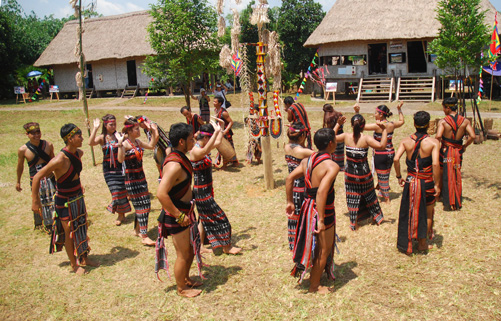
Stretching across the mountainous landscapes of Central Vietnam, the Truong Son Mountains are home to the Co Tu people, an ethnic community whose traditions have developed in close harmony with forests, villages, and the natural environment. Also known as the Katu, the Co Tu live mainly in Quảng Nam, Thừa Thiên–Huế, and Đà Nẵng, with related communities across the border in Laos.
With a population of 74,173 people in Vietnam according to the 2019 census, the Co Tu speak languages belonging to the Katuic branch of the Mon–Khmer language family.
A Highland Culture Shaped by Nature
For generations, Co Tu communities have lived in the mountainous areas along the Vietnam–Laos border. Their traditional way of life reflects a close relationship with the forests and surrounding landscape.
Traditional stilt houses are an important feature of Co Tu villages, while community life remains central to maintaining customs and cultural practices. In some border communities, traditional livelihoods have also included growing jute and weaving.
Flavors Preserved in Bamboo
One of the most distinctive aspects of Co Tu culture can be discovered through food. Traditionally, rice and other dishes are cooked inside bamboo tubes, using locally available ingredients and simple cooking techniques.
Traditional preparations include zăr, aví hor, koo dep, koo g’đhoong, and cha chắc. The Co Tu also traditionally enjoy tavak, a drink made from the sap of the tavak palm.
For travelers, exploring these dishes provides a flavorful introduction to the relationship between Co Tu cuisine and the mountain environment.
The Energy of Traditional Dance
Music and dance are an essential part of Co Tu cultural life, especially during community celebrations.
The tung tung is traditionally performed by men, while women perform the ya yá. Their movements and rhythms create a lively expression of community spirit and are an important part of traditional celebrations.
The h’roa, a traditional musical instrument, is also played in everyday life, adding another dimension to the community’s musical heritage.
Craftsmanship in Everyday Life
The Co Tu are known for their traditional handicrafts, including a wide variety of woven carrying baskets. These baskets are practical objects used in daily activities while also reflecting local craftsmanship and knowledge passed down through generations.
Weaving and other traditional skills demonstrate how Co Tu material culture has evolved from the needs of everyday life in a mountainous environment.
A Culture Moving with the Times
Modern life is bringing new opportunities and changes to Co Tu communities. Many young people now travel to cities for education and employment, while some continue their studies abroad.
At the same time, traditional food, music, dance, handicrafts, and village customs remain important expressions of Co Tu identity. The culture continues to evolve as younger generations find new ways to connect tradition with contemporary life.
Experiencing Co Tu Heritage
For travelers exploring Central Vietnam, a journey into Co Tu communities offers a chance to discover a side of the region beyond its well-known beaches and historical attractions.
From bamboo-cooked dishes and traditional dances to stilt houses and woven baskets, Co Tu heritage reveals a rich cultural world shaped by the Truong Son Mountains.
Exploring this heritage with respect and curiosity allows visitors to experience the cultural diversity of Central Vietnam while gaining a deeper appreciation for the communities that continue to preserve their traditions.