
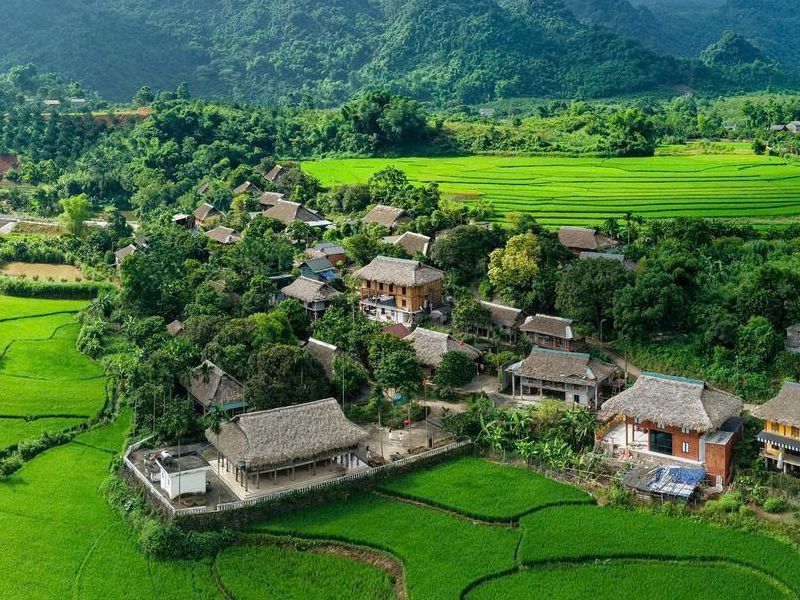
Nestled amid lush green mountains, terraced fields, and gentle streams, Mo Hamlet (Xóm Mỗ) in Thung Nai Commune, Phu Tho Province, offers visitors a peaceful glimpse into the traditional life of the Muong people. Beyond its scenic beauty, the hamlet preserves a rich cultural heritage and is gradually emerging as a distinctive community-based tourism destination.
In early 2025, Mo Hamlet was officially recognized as a four-star provincial OCOP community tourism destination, marking an important milestone in the local efforts to preserve traditional culture and promote sustainable tourism.
Preserving the Traditional Muong Stilt Houses
One of the first things visitors notice in Mo Hamlet is its traditional stilt houses nestled along the hillsides. These houses are an important symbol of Muong culture, reflecting both distinctive architectural features and the community’s traditional way of life.
The houses are typically built against the hillside to catch cool breezes and reduce humidity. Traditionally, they are divided into different levels serving various purposes. The lower level, once mainly used to house livestock, has now been renovated in many homes into comfortable living and accommodation spaces for visitors while retaining the distinctive character of traditional architecture.
According to hamlet head Dinh Van Dan, Mo Hamlet has welcomed visitors since the 1980s, making it one of the earliest community-based tourism destinations in the southern part of the province.
Community-Based Tourism Development
A major milestone in the development of tourism in Mo Hamlet was its participation in the “One Commune, One Product” (OCOP) Program for the 2023–2025 period. The four-star provincial OCOP recognition reflects the joint efforts of local authorities, residents, and the Mo Hamlet Community Tourism Cooperative.
Established in 2021 with 30 members, including 14 who currently meet the standards for providing overnight accommodation, the cooperative has been working to professionalize tourism services, create additional livelihoods for local residents, and promote sustainable tourism development.
Local residents are directly involved in providing accommodation, introducing traditional cuisine and culture, and organizing authentic tourism experiences. The hamlet’s art troupe also plays an important role in preserving local heritage by performing and teaching traditional Muong folk songs and dances.
Experiencing Local Life
Visitors to Mo Hamlet can stroll along winding village paths, admire the terraced fields, explore orange, pomelo, and banana gardens, and experience the everyday life of local residents.
Activities such as weaving, harvesting rice and corn, and catching fish in the streams give visitors an opportunity to gain a closer understanding of traditional agricultural life. These experiences are a distinctive feature of tourism in Mo Hamlet, allowing travelers not only to see the destination but also to engage with the local community.
Homestays in the hamlet have gradually been upgraded with essential amenities, including clean communal sleeping areas, hot water, and suitable sanitation facilities, providing visitors with greater comfort while maintaining the authentic atmosphere of a traditional village.
Local cuisine is another highlight, featuring flavorful specialties such as pork grilled and wrapped in pomelo leaves, bitter bamboo shoots, free-range chicken, and ruou can, a traditional fermented rice wine enjoyed communally through bamboo pipes.
With its harmonious natural landscape, distinctive stilt-house architecture, rich Muong cultural heritage, and strong community participation, Mo Hamlet is gradually establishing itself as an attractive community-based tourism destination in Phu Tho.
The development of tourism here not only creates new livelihood opportunities for local residents but also contributes to preserving traditional cultural values and introducing the unique heritage of the Muong community to domestic and international visitors.