
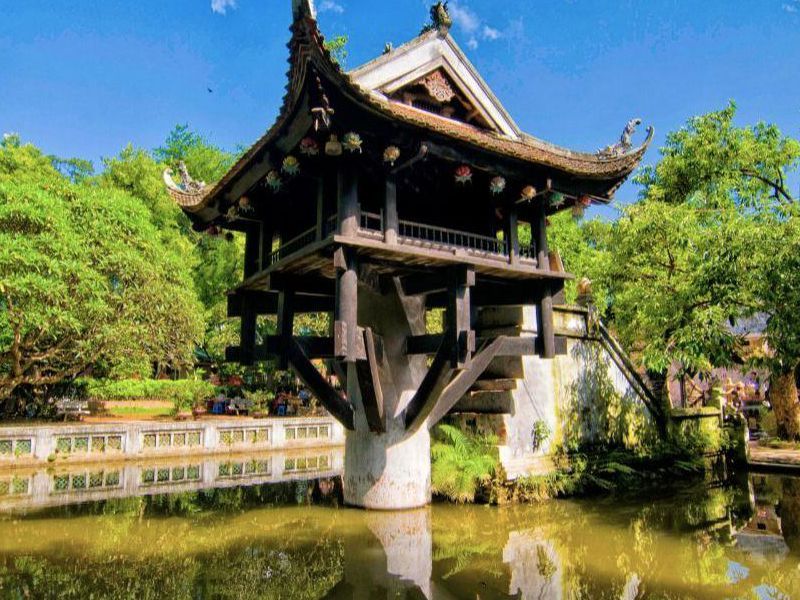
Located in the heart of Hanoi, One Pillar Pagoda is one of Vietnam’s most renowned and distinctive Buddhist architectural landmarks. The image of a small temple rising from a single stone pillar in the middle of a lotus pond has become an iconic symbol of Hanoi, familiar to both Vietnamese and international visitors.
With a history dating back to the Ly Dynasty, One Pillar Pagoda is closely associated with King Ly Thai Tong, the development of Buddhism, and the lotus – a symbol of purity and spiritual enlightenment. After nearly a millennium of historical changes, the structure seen today is the result of preservation and reconstruction based on its traditional architectural form.
One Pillar Pagoda Was Built in 1049
The pagoda is traditionally known by its Sino-Vietnamese name, Dien Huu Pagoda (延祐寺), and was built in 1049 during the reign of King Ly Thai Tong.
According to the Complete Annals of Dai Viet (Dai Viet Su Ky Toan Thu), King Ly Thai Tong once dreamed that Avalokiteshvara (Quan Am) was seated on a lotus throne and led the king onto the throne. After awakening, the king shared his dream with his courtiers.
A monk named Thien Tue interpreted the dream as an auspicious sign and advised the king to build a pagoda resembling the lotus throne he had seen in his dream. A stone pillar was therefore erected in the middle of a pond, with a small shrine placed on top to worship Avalokiteshvara.
The structure was completed in 1049 and was named Dien Huu, a name associated with the idea of lasting blessings and divine protection.
This story has become an important part of the history and legend surrounding One Pillar Pagoda, while also providing a traditional explanation for its distinctive lotus-like design rising above the water.
Dien Huu Pagoda and Lien Hoa Dai
When learning about One Pillar Pagoda, it is important to distinguish between the name of the pagoda and the famous architectural structure standing in the pond.
Dien Huu Pagoda refers to the pagoda itself, while the one-pillar structure in the middle of the pond is commonly known as Lien Hoa Dai, meaning “Lotus Tower.”
The popular name One Pillar Pagoda comes from the structure’s most distinctive architectural feature – a small shrine supported by a single stone pillar.
The design creates a striking visual impression: a Buddhist sanctuary rising from the water like a lotus flower in bloom.
The Lotus as the Inspiration Behind the Architecture
The lotus holds an important place in Vietnamese Buddhist culture. Growing from muddy water while remaining pure and beautiful, the flower is widely associated with purity, enlightenment, and transcendence.
For this reason, Lien Hoa Dai is not only remarkable from an architectural perspective but also carries profound symbolic meaning.
The structure is supported by a central stone pillar, with a small shrine built above it. Viewed from a distance, the entire composition resembles a lotus blossom emerging from the surface of a pond.
The harmonious combination of architecture, water, and the lotus image creates a distinctive space that reflects the connection between human beings, nature, and spiritual life.
Changes Through the Dynasties
After its original construction, Dien Huu Pagoda was expanded and renovated over the centuries.
In 1105, during the reign of King Ly Nhan Tong, the pagoda underwent a major renovation. Historical records indicate that the king ordered the complex to be repaired and additional structures to be built within the temple grounds.
This suggests that during the Ly Dynasty, Dien Huu Pagoda was once a much larger architectural complex than the One Pillar structure visitors see today.
Over the following centuries, the pagoda underwent further repairs and changes as a result of both natural deterioration and historical upheavals.
The Present Structure Is the Result of Reconstruction
An important point to note when introducing One Pillar Pagoda is that the structure standing today is not the entirely original building constructed in 1049.
During the turbulent period of modern Vietnamese history, the pagoda was destroyed in 1954, shortly before French forces withdrew from Hanoi.
The structure was subsequently reconstructed, with restoration completed in 1955 based on its traditional architectural form and surviving historical materials.
The significance of One Pillar Pagoda today therefore lies not only in its long history, but also in the efforts made to preserve, reconstruct, and maintain an architectural symbol that has been closely associated with Hanoi for generations.
A Cultural Landmark in the Heart of Hanoi
One Pillar Pagoda is located in the Ba Dinh District, close to several of Hanoi’s most important historical and cultural landmarks. Its central location makes it a convenient stop on a tour of the capital.
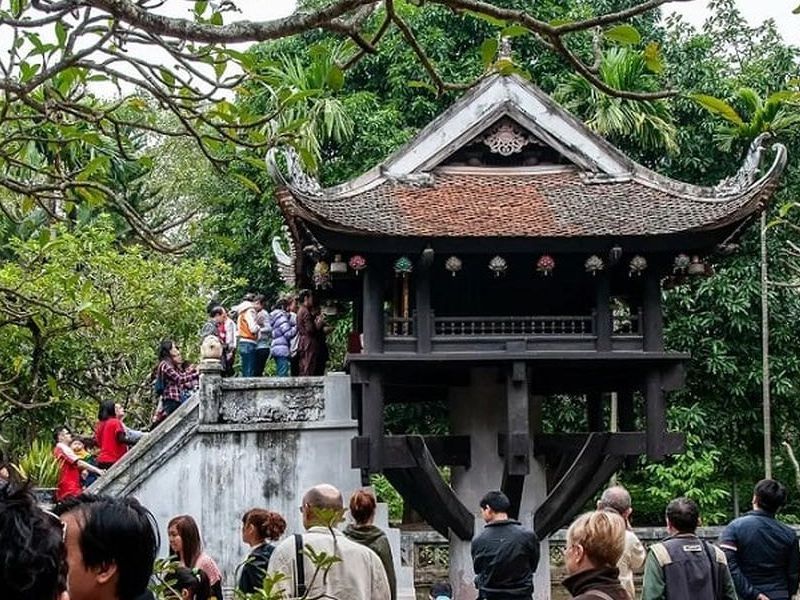
Visitors can easily combine a visit to the pagoda with nearby attractions such as Ba Dinh Square, the Ho Chi Minh Mausoleum, and the Ho Chi Minh Museum.
The area surrounding the pagoda is relatively peaceful, creating an interesting contrast with the lively rhythm of modern Hanoi.
For many visitors, the site is more than simply a place to sightsee and take photographs. It is also an opportunity to learn about Vietnamese Buddhist history, traditional architecture, and the spiritual life of the Vietnamese people.
An Architectural Symbol of Hanoi
After nearly a thousand years of history, the image of One Pillar Pagoda has become an inseparable part of Hanoi’s cultural identity.
Its small yet distinctive architecture frequently appears in books, paintings, souvenirs, and promotional materials featuring Vietnam.
In 1962, One Pillar Pagoda was officially recognized as a National Historical and Architectural-Artistic Relic.
The value of the monument does not lie in its size, but in its unique architectural character, historical depth, and the cultural and spiritual meanings that have been passed down through generations.
Discovering One Pillar Pagoda
Today, One Pillar Pagoda remains one of the most popular landmarks for visitors exploring Hanoi.
Standing above the water like a lotus in bloom, the structure possesses a simple yet unforgettable beauty. Here, history, Buddhist architecture, and traditional Vietnamese art come together in a remarkably compact space.
For travelers seeking to understand the deeper cultural character of Hanoi, One Pillar Pagoda is a destination worth visiting. From the legendary dream of King Ly Thai Tong to its reconstruction in the 20th century, the pagoda stands as a testament to the enduring vitality of Vietnam’s cultural heritage.
Modest in scale yet rich in history and symbolism, One Pillar Pagoda continues to stand as one of Hanoi’s most distinctive landmarks – a place where history, spirituality, and architectural artistry converge.