
The Hani Homeland and Communities
The Hani people are a Lolo-speaking ethnic group living mainly in southern China, northern Vietnam, and northern Laos. In Vietnam, they mainly live in Lai Chau and Lao Cai Provinces. In China, most Hani people live in Yunnan Province, particularly in the area between the Mekong River and the Red River. Their mountainous environment has played an important role in shaping their traditional lifestyle and agricultural practices.
Ancestral Origins and Oral Traditions
The exact origins of the Hani people remain uncertain. Some theories suggest that their ancestors were related to the ancient Qiang peoples and migrated southward from the Qinghai–Tibetan Plateau before the third century CE. According to Hani oral traditions, they are descended from the Yi people and separated from them as a distinct community many generations ago. Reciting the names of ancestors from one generation to another is an important tradition that helps preserve the community’s historical memory.
Houses, Clothing, and Folk Arts
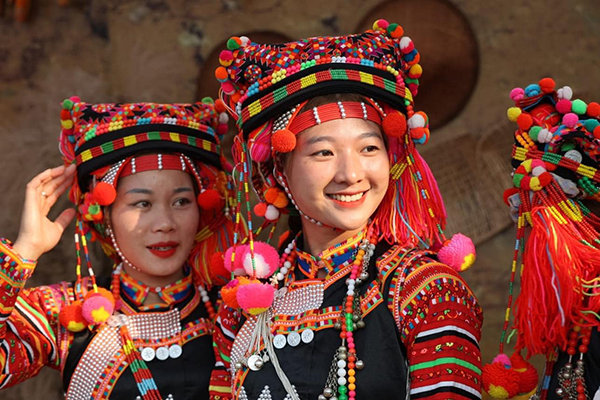
Traditional Hani houses are usually two or three stories high and are built from local materials such as bamboo, mud, stone, and wood. Traditional clothing is mainly made from dark-blue fabric. Men commonly wear short jackets, loose trousers, and white or black turbans, while women’s clothing varies among different Hani groups and communities.
Music is also an important part of Hani cultural life. The Hani are well known for their polyphonic singing, in which several voices combine to create different musical parts. Traditional musical instruments include the labi, an end-blown flute, and the lahe, a three-stringed plucked lute.
The Spiritual World and Traditional Rituals
Hani spiritual life is closely connected with polytheistic beliefs and respect for ancestral spirits. They traditionally perform various rituals to seek protection, peace, and good fortune from gods and spirits.
Three important figures play roles in traditional religious practices: the zuima, who leads major ceremonies; the beima, who performs exorcisms and spiritual rituals; and the nima, who is responsible for divination and the use of medicinal herbs. The role of nima can be performed by both men and women. Today, some Hani people also practice Theravada Buddhism.
Language and Linguistic Heritage
The Hani language belongs to the Lolo-Burmese branch of the Sino-Tibetan language family. Oral traditions play an important role in preserving the history, legends, and knowledge of the community. According to tradition, the Hani once had an ancient writing system, but it was lost during their migration. Today, a Romanized writing system based on the Luchun dialect is used to represent the Hani language.
Terraced Rice Fields – A Mountain Heritage
Terraced rice fields are one of the most distinctive features of Hani culture. For more than 1,300 years, the Hani people have developed an agricultural system that combines forests, villages, rice terraces, and water sources. They have accumulated extensive knowledge of traditional rice varieties and biodiversity conservation.
The Hani also combine rice cultivation with fish and duck farming, use green manure to improve soil fertility, and channel water from forested mountains into the terraces. These practices help maintain a sustainable agricultural ecosystem without relying heavily on large water reservoirs.
The rice terraces provide not only food but also demonstrate the harmonious relationship between people and nature. The Honghe Hani Rice Terraces were recognized as a UNESCO World Heritage Site in 2013, highlighting the outstanding value of this traditional agricultural system.
Preserving Heritage in Modern Life
Today, urbanization and changes in lifestyle create challenges for the preservation of Hani culture. In particular, fewer young people are familiar with traditional terraced farming techniques.
However, Hani communities continue to preserve their language, customs, festivals, and traditional farming practices. Combining cultural preservation with tourism development and agricultural support can help maintain the terraced landscape while providing additional livelihoods for local people.
Hani culture reflects a deep relationship between people, nature, and community. The knowledge passed down through generations not only helps the Hani adapt to their mountainous environment but also contributes to biodiversity conservation and the cultural diversity of the region.