
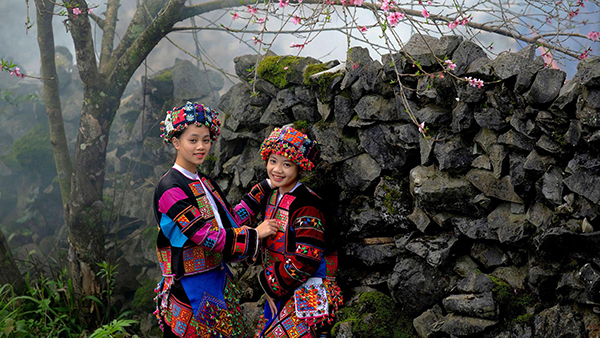
The Yi people, also known as the Nuosu, are one of the largest ethnic minority groups in China. With a population of approximately nine million, they mainly live in the provinces of Yunnan, Sichuan, Guizhou, and Guangxi, particularly in mountainous and remote areas. In Vietnam, a subgroup of the Yi, known as the Lô Lô, mainly lives in the northern mountainous provinces of Ha Giang, Cao Bang, and Lao Cai. The differences in geography and climate have contributed to the diversity of lifestyles and cultural practices among Yi communities.
Names and Groups of the Yi People
The Yi people have many different names for themselves, including Nuosu, Nisu, Nasu, Sani, and Lolo. Although different groups may speak different languages that are sometimes mutually unintelligible, they are officially recognized as one ethnic group.
The name Lolo is associated with the traditional beliefs of the Yi people, particularly their respect for the tiger. In some Yi dialects, “lo” means “tiger.” Therefore, the tiger holds an important place in Yi culture and spiritual life.
History and Origins
According to Yi mythology, all life originated from water. Their common ancestor is believed to have been Apu Dumu. According to the legend, Apu Dumu had three wives and six sons. The six sons later migrated to different areas and established various clans, contributing to the formation of Yi communities.
The history of the Yi people is closely connected with migration, clan organization, and adaptation to mountainous environments. These living conditions have contributed to the development of diverse customs and cultural practices among different Yi communities.
Language and Writing System
The Yi people speak several languages belonging to the Loloish language group, which is closely related to languages in the Tibeto-Burman family. Six major Yi language groups are generally recognized: Nuosu, Lalo, Lolopo, Nisu, Sani, and Nasu.
Among them, Nuosu has the largest number of speakers and plays an important role in Yi cultural life. The Yi people also have their own writing system, known as the Yi script, which has traditionally been used to record their language, religious texts, legends, and traditional knowledge.
Culture and Social Life
Yi culture is rich and has been strongly influenced by the mountainous environment in which the people have traditionally lived. In traditional Yi society, family and clan relationships play an important role. The Yi also have a distinctive naming system in which part of a father’s name may be passed on to his child, creating a connection between generations.
In addition, the Yi people have many distinctive customs, traditional clothing, music, festivals, and legends. Although these cultural practices vary from one region to another, they all contribute to the shared cultural identity of the Yi people.
Religion and Spiritual Beliefs
One of the most distinctive aspects of Yi culture is Bimoism, the traditional indigenous religion of the Yi people. Religious ceremonies are conducted by bimo, who are respected specialists knowledgeable about rituals, sacred texts, the Yi language, and traditional customs.
Bimo play an important role in ceremonies related to daily life, ancestors, health, and the community. They are traditionally recognized by their distinctive black robes and large hats.
Traditional Medicine
The Yi people have developed a rich system of traditional medicine that has been accumulated and passed down through many generations. Knowledge of medicinal plants, healing practices, and healthcare methods has been transmitted through both oral traditions and written records.
Traditional medicine reflects not only the Yi people’s experience of adapting to their natural environment but also an important part of their cultural heritage.
Cultural Values of the Yi People
The Yi people have a long history and a rich and diverse cultural heritage. Their language, writing system, religious beliefs, customs, social traditions, and traditional medicine all reflect their distinctive cultural identity. Although Yi communities live in different regions and have developed different languages and customs, they continue to preserve many important cultural traditions across generations. These cultural values contribute to the rich diversity of ethnic cultures in China and Southeast Asia.