
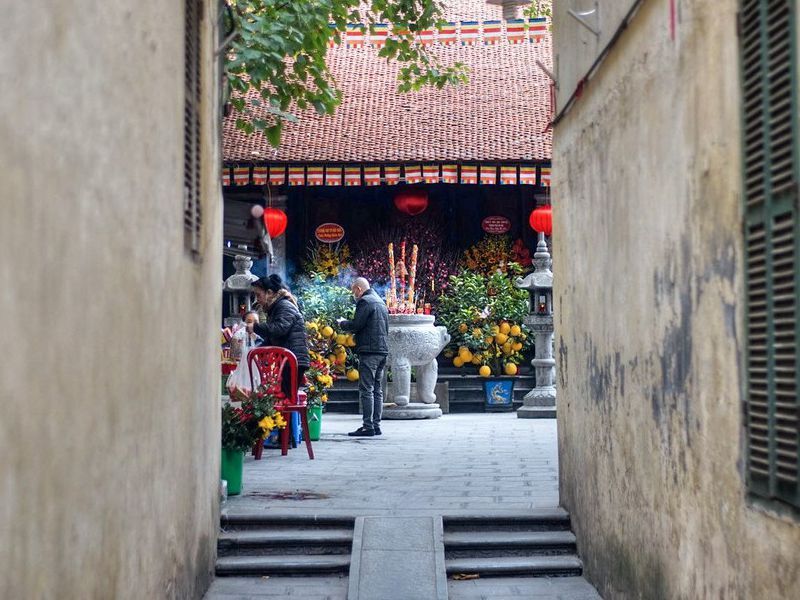
Ba Da Pagoda, also known as Linh Quang Pagoda, is located at No. 3 Nha Tho Street, Hang Trong Ward, Hoan Kiem District, Hanoi, approximately 100 meters from Hoan Kiem Lake. Tucked away in a quiet alley in the bustling Old Quarter, the pagoda is a historic Buddhist site that reflects the spiritual traditions and cultural heritage of ancient Thang Long, the former name of Hanoi.
According to local legend, in the late Le–Trinh period, around 1767–1782, villagers were digging earth near the pagoda to collect material for the Thang Long Citadel when they discovered a stone statue. Believing it to represent the Goddess of Mercy, they respectfully enshrined it at the temple. The discovery is said to have inspired the name Ba Da Pagoda, which means “Stone Lady Pagoda” in Vietnamese. Its formal Buddhist name is Linh Quang Tu. The story of the stone statue has become part of the pagoda’s spiritual heritage and local cultural memory.
Historical accounts suggest that in 1786, during the Tây Sơn campaign into Thang Long, the pagoda suffered damage from warfare and fire and was left in ruins. Local residents later rebuilt a modest structure using bamboo and thatch so that Buddhist worship could continue. In 1793, Buddhist master Khoan Giai reportedly became abbot and began rebuilding the temple, starting with a three-bay structure topped with a tiled roof. According to the accounts provided, Master Giac Vuong succeeded him in 1821 and organized donations to expand the complex with corridors, monks’ quarters, and guest rooms. Over the following years, restoration work helped the pagoda regain its role as an important Buddhist sanctuary in the heart of the historic capital.
Ba Da Pagoda is associated with the Lam Te Zen tradition, a major school of Vietnamese Buddhism with a long history in northern Vietnam. As an important center of Buddhist practice, the pagoda has helped preserve religious teachings, maintain traditional rituals, and promote Buddhist values within the local community across generations.
The pagoda is also linked to revolutionary activities during the resistance against French colonial rule. Historical accounts describe it as a place used by Viet Minh cadres as a route and operational base. After the Unified Vietnamese Buddhist Association was established in May 1958, the pagoda became the headquarters of the Hanoi Buddhist Liaison Board. Following the establishment of the Vietnam Buddhist Sangha in November 1981, it continued to play a significant role in the capital’s Buddhist community and served as the headquarters of the Hanoi Buddhist Sangha. The pagoda has also been associated with Buddhist education and the training of monks and nuns in Hanoi.
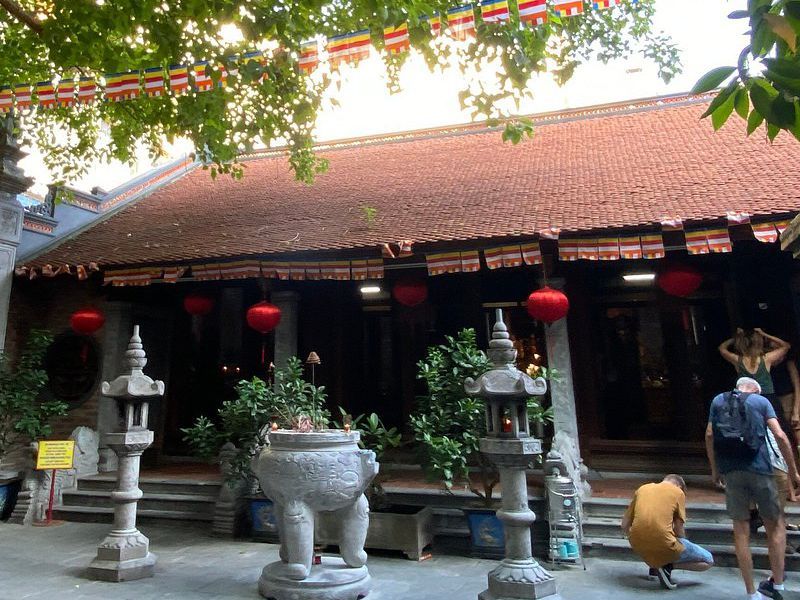
The architectural complex includes a five-bay front hall, a four-bay main sanctuary, an ancestral hall, and a shrine dedicated to the Mother Goddess. Unlike many traditional Vietnamese pagodas, Ba Da Pagoda does not have a prominent triple gate. Instead, visitors enter through a narrow alley approximately nine meters deep, creating a sense of seclusion from the busy streets outside. One of its distinctive architectural features is the low porch roof supported by four stone columns. These columns are decorated with traditional carvings representing the four seasons and the tu quy motif, a traditional set of four auspicious plants associated with seasonal change in East Asian art.
Inside the pagoda, visitors can admire wooden Buddhist statues finished in red lacquer and gold leaf. The collection includes the Three Buddhas representing the past, present, and future; the Amitabha Triad; and Shakyamuni Buddha accompanied by the bodhisattvas Manjushri and Samantabhadra. Together, these statues contribute to the solemn and contemplative atmosphere of the sanctuary. The pagoda also preserves several historical artifacts, including two bronze bells cast in 1873 and 1881, as well as a bronze khanh, a traditional percussion instrument used in religious settings, cast in 1842. These objects offer a glimpse into the temple’s long history and the Buddhist traditions of Hanoi.
Despite the rapid pace of modern life in the Old Quarter, Ba Da Pagoda retains its quiet and contemplative character. It offers visitors an opportunity to explore Vietnamese Buddhist history, appreciate traditional temple architecture, and discover a more tranquil side of Hanoi. If you are visiting St. Joseph’s Cathedral or Hoan Kiem Lake, consider stopping by Ba Da Pagoda to learn about its history and experience a spiritual landmark that has remained part of Hanoi’s cultural landscape for generations.