
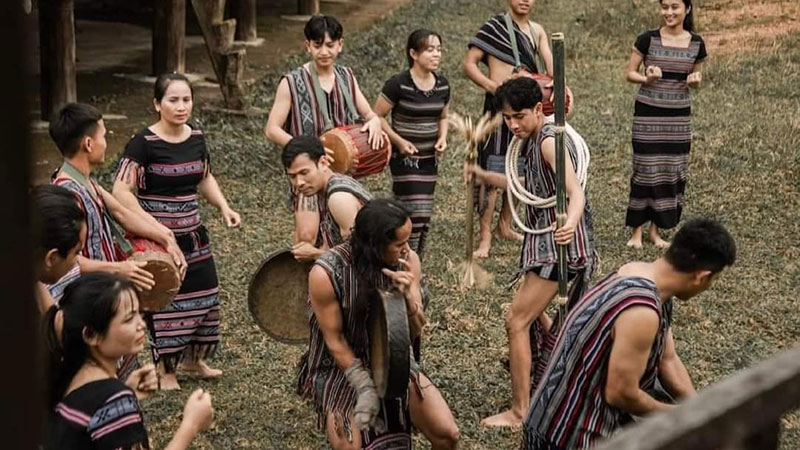
In the green mountains of Central Vietnam, the H’rê people have preserved a distinctive cultural identity shaped by their close relationship with rivers, rice fields, and village life. As a Mon–Khmer-speaking ethnic group, the H’rê mainly live in Quảng Ngãi Province, with smaller communities in Bình Định and Kon Tum.
A Community Rooted in Central Vietnam
Quảng Ngãi is home to the largest H’rê population, particularly in Ba Tơ, Sơn Hà, and Minh Long districts. In 2015, more than 132,000 H’rê people were recorded in the province.
Historically, the H’rê often identified themselves through the names of the rivers and areas where they lived. During the Nguyễn dynasty, they were also known by several names, including Chăm Rê, Chăm Quảng Ngãi, Thượng Ba Tơ, Man Thạch Bích, and Mọi Đá Vách.
Today, their communities remain closely connected to the mountainous landscapes of Central Vietnam.
Rice Fields at the Heart of Village Life
Agriculture has traditionally been the foundation of H’rê life. Wet-rice cultivation is the main form of farming, while a smaller number of households practice slash-and-burn agriculture.
Buffaloes, pigs, dogs, and chickens are commonly raised alongside crop cultivation. These activities reflect a largely self-sufficient rural lifestyle in which farming, livestock, and family life are closely connected.
Traditional handicrafts include bamboo and rattan weaving as well as textile production. Although these crafts have declined over time, weaving traditions are still maintained in several H’rê communities, offering visitors an opportunity to discover another aspect of local craftsmanship.
When Three Gongs Tell a Story
One of the most distinctive features of H’rê cultural life is the chiêng Ba, a set of three gongs traditionally described as the father, mother, and child.
The three gongs are played together during traditional festivals and community gatherings. Their music follows four basic melodies: Chinh Năng, Chinh K’oa, Chinh H’lay, and Chinh Tuguốc.
More than musical instruments, the gongs form part of the community’s cultural and ceremonial life. Their sounds bring villagers together and create a lively atmosphere during important occasions.
Discovering H’rê Heritage
For travelers exploring Central Vietnam, H’rê communities offer a different perspective on the region beyond its famous beaches and historical sites. Visiting local villages can provide a closer look at traditional farming, handicrafts, community gatherings, and the enduring sound of the chiêng Ba.
Experiencing H’rê culture is ultimately a journey into everyday life: walking through mountain villages, seeing rice fields shaped by generations of farming, and listening to traditional gong melodies that continue to connect the community with its heritage.
The H’rê cultural landscape of Central Vietnam is a reminder that some of the region’s most meaningful travel experiences can be found not only in famous destinations, but also in the traditions and daily lives of its ethnic communities.