
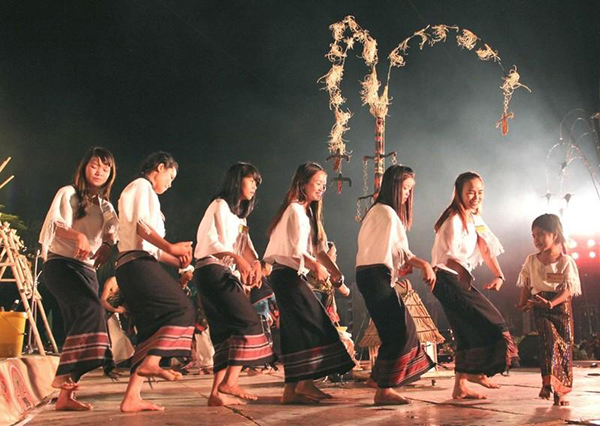
A Highland Community with a Distinct Identity
The Churu are one of the ethnic communities living mainly in Lâm Đồng Province in Vietnam’s Central Highlands. Their language and cultural traditions are closely connected to the Cham people and other Austronesian-speaking communities of mainland Southeast Asia. Over generations, the Churu have developed a distinctive way of life shaped by the mountains, rivers, forests, and fertile valleys of the highlands.
Their culture reflects both ancient connections with the Cham and long periods of interaction with neighboring highland communities, particularly the K’Ho.
From the Coastal Plains to the Highlands
According to Churu oral traditions, their ancestors once lived closer to the Cham communities along the coast before gradually moving into the Central Highlands. Historical changes, conflicts, and shifting political boundaries may have contributed to these movements.
The relationship between the Churu and Cham can still be seen in several aspects of Churu culture, including wet-rice farming, pottery, weaving, agricultural practices, and oral traditions. Historical studies have also pointed to long-standing connections between Cham communities and the peoples of the highlands, particularly after major political changes in the Cham kingdom in the late 15th century.
Over time, however, the Churu developed their own cultural identity, adapting older traditions to the environment and social life of the Central Highlands.
Rice Fields and Life by the Streams
Agriculture has traditionally been at the heart of Churu life. In areas with suitable terrain, they developed wet-rice cultivation and irrigation systems, making use of streams and natural water sources.
Rice was accompanied by corn, vegetables, and other crops, while cattle, buffaloes, and poultry provided additional food and helped with agricultural work. Traditional farming tools were simple but carefully adapted to the local landscape.
For the Churu, the river and the fields were more than sources of food. They were closely connected to community life and to the spiritual beliefs surrounding nature.
What the Forest Provides
The forest has also long played an important role in Churu life. Hunting, gathering wild vegetables, collecting fruits, and finding medicinal plants once provided important sources of food and materials.
Although these practices have declined as modern agriculture and changing lifestyles have transformed highland communities, knowledge of the forest remains part of Churu cultural memory.
A Spiritual World of Nature
Traditional Churu beliefs are closely connected to nature. Mountains, rivers, forests, and other elements of the natural world were believed to be inhabited or influenced by spiritual forces, commonly associated with Yàng and Pô.
Among these traditions are rituals connected with Bok Bơmung and other local spiritual practices. Later, Christian missionary activity introduced new religious influences, while historical contact with Islam also left traces of interaction between the Churu, Cham, and surrounding communities.
Rather than disappearing completely, older beliefs have often continued alongside newer religious practices, reflecting the cultural changes experienced by the Churu over time.
Traces of Cham Heritage
Cham influence remains one of the most fascinating aspects of Churu culture. Similarities can be found in pottery, weaving, agricultural traditions, and oral memories of ancestral connections.
Stories associated with figures such as Po Rome also appear in the broader cultural memory shared by Cham and Churu communities. Other historical figures and local traditions, including stories of Touneh Hàn Đăng, further reflect the complex cultural connections between the coastal Cham world and the Central Highlands.
Yet Churu culture should not be viewed simply as a branch of Cham culture. Through centuries of migration, adaptation, and interaction with neighboring peoples, the Churu have created a cultural identity of their own.
The Churu Today
Today, the Churu live between tradition and modern life. Farming remains important, while education, tourism, migration, and new economic opportunities have brought significant changes to their communities.
Traditional knowledge, crafts, rituals, and oral traditions continue to be passed down, although some practices are becoming less common among younger generations. Efforts to preserve these traditions are therefore increasingly important.
For visitors to Lâm Đồng and the Central Highlands, learning about the Churu offers a different perspective on the region’s history. Their story is not only about a highland ethnic group, but also about centuries of migration, cultural exchange, and adaptation.
The Churu heritage carries traces of distant coastal connections while remaining deeply rooted in the mountains of the Central Highlands—a culture shaped by movement, yet defined by a strong sense of identity.