
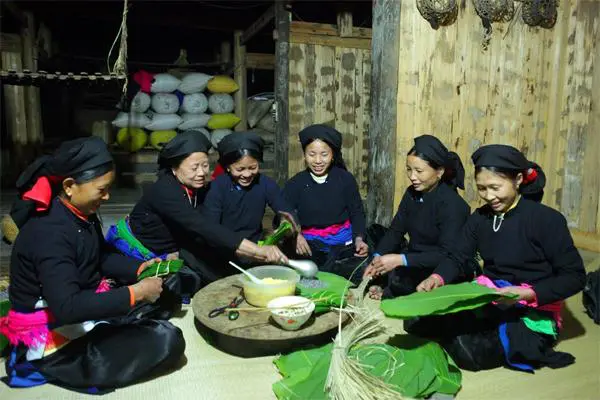
Amid the rugged mountains of northeastern Vietnam, the La Chi people are one of the ethnic communities that contribute to the rich cultural diversity of Ha Giang and Lao Cai. According to the 2019 population census, there were 15,126 La Chi people, living mainly in several areas of these two provinces. The La Chi language belongs to the Tai–Kadai language family, reflecting the long-standing cultural and linguistic connections among communities in northern Vietnam.
Life in the Northern Highlands
The La Chi mainly live in Ban Phung, Ban Diu, and Ban May communes in Ha Giang, as well as in several areas of Lao Cai. Their traditional way of life has long been closely connected with the mountains, farmland, and agricultural activities that surround their villages.
According to La Chi tradition, Hoang Din Thung is regarded as an ancestral figure of the community. Stories about their origins and ancestors have been passed down through generations, helping preserve a shared sense of heritage and strengthen the bonds between community members.
Knowledge Rooted in the Land
Agriculture is not only an important livelihood for the La Chi but also an integral part of their cultural life. Traditionally, the community set aside some of the most fertile land for growing cotton and Strobilanthes flaccidifolius Nees, a plant associated with traditional production and local knowledge.
These practices reflect the La Chi people’s close understanding of their natural surroundings. Knowledge of soil, crops, and seasonal farming has been passed from one generation to another, becoming an important part of the community’s traditional knowledge.
The Meaning of Ní Ca Singing
While farming connects the La Chi to the land, Ní Ca singing plays an important role in bringing people together. Traditional songs provide a way for people to express feelings, share thoughts, and tell stories connected with everyday life.
More than a form of entertainment, Ní Ca also helps preserve the community’s language and spiritual values. Through songs passed down over generations, elements of La Chi culture continue to find a place in contemporary community life.
Khu Cù Tê: A Time for Community
One of the important occasions in the La Chi cultural calendar is the Khu Cù Tê Festival, held during the seventh month of the lunar year.
During the festival, community members gather to take part in traditional rituals and communal activities. The celebration has spiritual significance while also providing an opportunity for people to meet, share experiences, and strengthen relationships within the community.
Through rituals and practices maintained over generations, Khu Cù Tê has become an important occasion for the La Chi to express and pass on their cultural values.
A Heritage That Continues
The La Chi are known by several names, including Cù Tè, Ý Pi, Ý Tó, Ý Poong, and Ý Mia. In historical records and among neighboring communities, they have also been referred to by names such as Black Thổ, Mán La Chí, and Xá.
Today, modernization is bringing changes to many aspects of La Chi life. Nevertheless, values associated with the land, agriculture, traditional songs, festivals, and ancestral memory continue to play an important role in the community.
From villages scattered across the mountains of Ha Giang and Lao Cai, La Chi culture continues to be passed from one generation to the next. Through traditional customs, songs, and festivals, the community preserves a distinctive cultural identity that adds another unique color to the diverse heritage of northeastern Vietnam.