
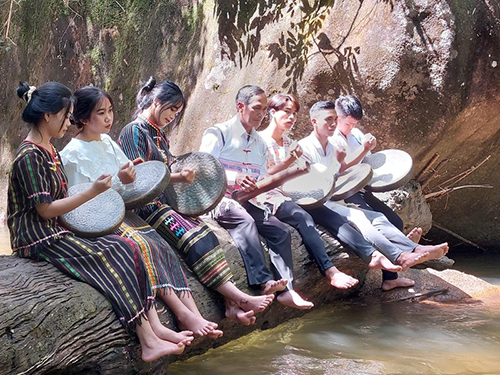
Amid the mountains of Vietnam’s Central Highlands and the upper reaches of the Dong Nai River, the Mạ people have preserved a distinctive cultural identity shaped by their language, history, traditions, and rich oral heritage. Primarily living in Lam Dong and Dong Nai provinces, the Mạ are one of the Indigenous communities that contribute to the cultural diversity of southern Vietnam.
For travelers interested in cultural discovery, learning about the Mạ offers an opportunity to explore the region beyond its beautiful landscapes and discover the stories, traditions, and way of life of a community closely connected to the mountains and forests.
A Community Closely Connected to Nature
According to population data from 2019, the Mạ community in Vietnam numbered approximately 50,322 people. They are concentrated mainly in Lam Dong and Dong Nai provinces, particularly around the upper basin of the Dong Nai River.
In Lam Dong, Mạ communities are found in areas including Bao Loc, Bao Lam, Da Huoai, Da Teh, Duc Trong, and Di Linh. Another part of the community lives in Dinh Quan District of Dong Nai.
The surrounding mountains, forests, rivers, and streams have played an important role in shaping Mạ life and culture. Their close relationship with the natural environment can be seen in traditional customs, beliefs, stories, and knowledge passed down through generations.
A History Shaped by Change
Before the 19th century, the Mạ had developed a certain degree of social and political organization. Some historical and ethnographic sources associate this development with broader regional interactions, including influences connected with Funan.
Over time, however, traditional Mạ society experienced major changes. French colonial rule, conflicts between different groups, and the slave trade all contributed to changes in the community’s traditional social structure and way of life.
Today, the history of the Mạ can be explored through ethnographic studies, linguistic research, and oral traditions preserved within the community.
The Mạ Language and Its Regional Varieties
The Mạ, or Maa, language belongs to the Mon–Khmer group of languages and is closely related to the Kơho language. Linguistic research has examined the relationship between Mạ and Kơho, reflecting the long history of cultural contact among communities living in the region.
Several Mạ subgroups are mentioned in ethnographic and linguistic studies, including:
- Mạ Ngăn: mainly associated with the Đạ Đơng River basin.
- Mạ Tô: found around the upper La Ngà River and the B’Lao plateau, with close contact with Kơho communities.
- Mạ Krung or Mạ Đa Gui: living from southern Bảo Lộc and Đạ Huoai toward Định Quán.
- Mạ Xốp: mainly associated with the Lộc Bắc and Lộc Trung areas.
These regional varieties reflect the diverse settlement patterns of the Mạ and their long-standing connection with the landscapes surrounding the Đồng Nai River basin.
Stories Passed Down Through Generations
One of the most fascinating aspects of Mạ culture is its rich oral tradition.
Myths, legends, parables, and traditional stories have been passed down from one generation to another. They provide insights into how the Mạ understand nature, human relationships, community life, and the spiritual world.
For travelers, these stories offer a deeper way to experience the region. A river can be more than a geographical feature; a forest can hold memories and legends; and a village can become a place where generations of cultural knowledge continue to live.
French ethnographer Jean Boulbet lived and conducted research in areas that are now part of Cát Tiên and Bảo Lâm during the 1950s and 1960s. His work documented various aspects of Mạ life, including customs, beliefs, cultural geography, and traditional knowledge of plants and the natural environment.
Exploring Mạ Culture Through Travel
A journey to discover Mạ culture can be combined with exploring the landscapes of Bảo Lộc, Bảo Lâm, Đạ Huoai, Đạ Tẻh, and Cát Tiên. These areas offer a combination of mountains, forests, rivers, streams, and diverse ecosystems.
Travelers interested in cultural tourism can seek opportunities to meet local residents, learn about traditional life, and listen to stories about the land. Community-based tourism can provide a meaningful way to experience local culture while supporting connections between visitors and residents.
Respect is also an important part of cultural travel. Visitors should learn about local customs, ask permission before photographing people, and avoid entering private or sacred spaces without permission.
A Cultural Heritage Along the Đồng Nai River
From its Mon–Khmer language and historical traditions to its myths, legends, and oral heritage, Mạ culture contributes an important part of the cultural diversity of Lâm Đồng and southeastern Vietnam.
For travelers seeking cultural experiences and Indigenous heritage, discovering the Mạ offers more than a journey through mountains and forests. It is an opportunity to listen to local stories, learn about a distinctive cultural tradition, and gain a deeper appreciation for a community whose history and identity remain closely connected to the land around the Đồng Nai River.