
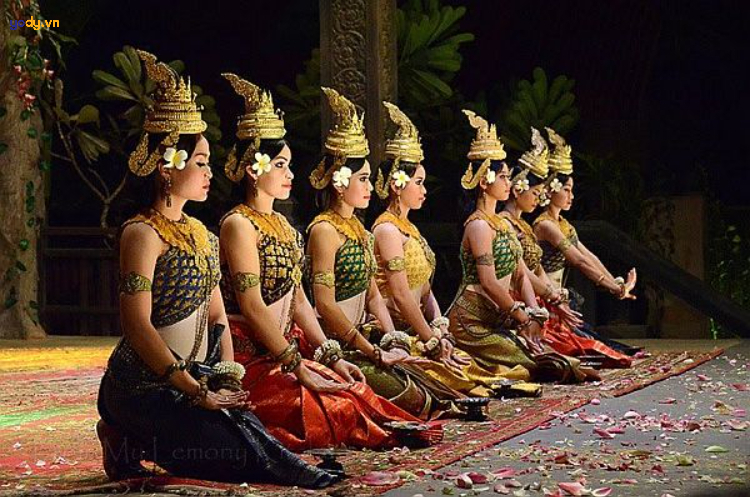
When people think of Khmer culture, images of ancient temples, the architectural legacy of Angkor, and the graceful movements of Apsara dancers often come to mind. Over thousands of years, the Khmer people have developed a rich cultural heritage shaped by Indigenous beliefs, Hindu traditions, and Theravada Buddhism.
Today, these traditions continue to live through religious practices, festivals, performing arts, architecture, and community life among Khmer communities in Cambodia, Thailand, Vietnam, and Laos.
The Khmer People and Their Cultural World
The Khmer people are an ethnic group belonging to the Austroasiatic language family, with Khmer as their principal language. Most Khmer people live in Cambodia, while significant communities have long lived in northeastern Thailand, Vietnam’s Mekong Delta, and parts of Laos.
The majority of Khmer people practice Theravada Buddhism. At the same time, traditional beliefs involving ancestor worship, spirits, animism, and elements inherited from Hindu traditions remain part of the wider cultural landscape.
This combination has created a distinctive cultural world in which temples, festivals, music, dance, and traditional ceremonies continue to play important roles.
Legends of Khmer Origins
Khmer culture preserves several traditional stories about the origins of the Khmer people.
One legend tells of the union between Kambu, a Brahmana figure, and Mera, an Apsara or celestial maiden. Another widely known story centers on Kaundinya and Princess Soma, also associated with the Neang Neak tradition.
According to the legend, Kaundinya arrived in Southeast Asia after following a vision and eventually married Princess Soma, who was associated with the Naga lineage. Their union is traditionally connected with the origins of Cambodia.
The story of Kaundinya and Soma continues to appear in traditional Khmer wedding ceremonies and remains an important part of Khmer cultural memory.
The Legacy of Ancient Khmer Civilization
The Khmer are one of the long-established peoples of mainland Southeast Asia. Over the centuries, they developed powerful kingdoms and cultural centers, most notably the Khmer Empire, which influenced large parts of Southeast Asia for several centuries.
Among the most remarkable surviving legacies is the architectural complex of Angkor.
The temples and monuments of Angkor represent not only extraordinary architectural and artistic achievements but also the religious worldview of ancient Khmer society, in which sacred mountains, temples, and deities played central roles.
Apsara Dance – A Symbol of Khmer Art
Among the many forms of Khmer traditional art, Apsara dance has become one of the best-known cultural symbols.
In Khmer tradition, Apsaras are celestial dancers associated with the divine world. Their graceful figures can be seen carved into the walls and galleries of ancient temples, particularly throughout the Angkor complex.
Dance has played an important role in Khmer culture since ancient times. It was performed in religious and royal ceremonies, and during the Angkor period, temple dancers were associated with sacred rituals and performances dedicated to the divine.
Today, Khmer classical dance continues to be performed at cultural events and for visitors interested in Cambodia’s artistic heritage. In 2003, Royal Ballet of Cambodia, representing the Khmer classical dance tradition, was inscribed on UNESCO’s Representative List of the Intangible Cultural Heritage of Humanity.
Khmer Culture in Everyday Life
Beyond dance, Khmer cultural identity is expressed through music, traditional clothing, temple architecture, and seasonal celebrations.
Traditionally, many Khmer communities have depended on agriculture, particularly rice cultivation, while others have relied on fishing and river-based livelihoods. The Wat, or Buddhist temple, remains an important center of religious and community life.
Among the major traditional celebrations are Chol Chhnam Thmey, the Khmer New Year, and Pchum Ben, a festival dedicated to remembering ancestors. These occasions are not only religious events but also important opportunities for families and communities to gather and pass cultural traditions to younger generations.
A Rich Spiritual World
Khmer spiritual life reflects the interaction between Theravada Buddhism and older local beliefs.
Alongside Buddhist practices at temples, many communities maintain beliefs concerning ancestral spirits, protective spirits, and supernatural beings associated with homes, forests, trees, land, and water.
These traditions contribute to a rich spiritual landscape in which everyday life, religious practice, nature, and ancestral memory remain closely connected.
Discovering Khmer Culture Through Travel
For travelers, discovering Khmer culture means more than visiting ancient monuments. It can also mean watching an Apsara performance, visiting a Buddhist temple, experiencing a traditional festival, exploring Khmer cuisine and crafts, or listening to stories passed down through generations.
From Cambodia to Khmer communities in Thailand and Vietnam, local traditions have developed distinctive characteristics. Differences in dialects, customs, and artistic practices add to the diversity of the broader Khmer cultural world across mainland Southeast Asia.
A Cultural Journey Through Khmer Heritage
From Apsara figures carved into ancient stone to graceful movements on contemporary stages, Khmer traditional arts demonstrate the enduring vitality of a culture shaped over many centuries.
For travelers interested in cultural tourism, history, and traditional arts, exploring Khmer heritage offers a journey into a fascinating world where ancient temples, music, dance, festivals, religious traditions, and community life come together to tell the story of one of Southeast Asia’s most distinctive cultural traditions.