
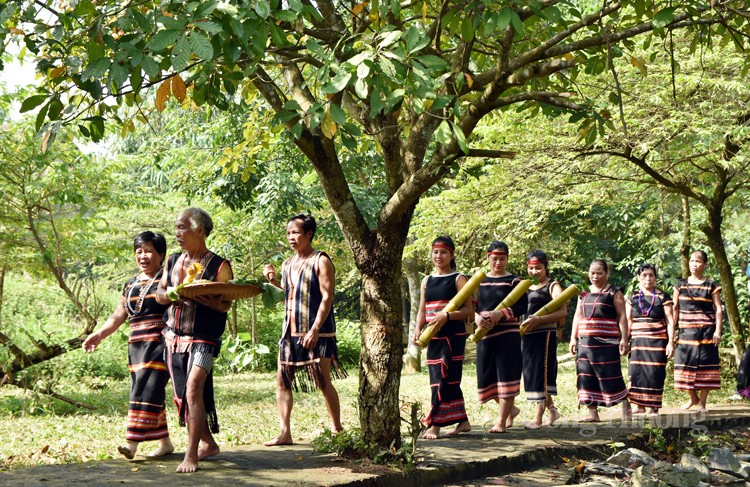
The Sedang, also known as Xê Đăng or Xơ Đăng in Vietnamese, are one of the ethnic communities that have long lived in the northern Central Highlands of Vietnam. They are mainly concentrated in Kon Tum Province, with communities also found in mountainous areas of Quang Nam and Quang Ngai. The Sedang include several local groups, such as Xteng, Kayong, Halang, Monom, and Todrah, each contributing its own customs and cultural characteristics.
The Sedang language belongs to the Northern Bahnaric branch of the Mon–Khmer language family. While these groups share many cultural traditions, centuries of interaction with neighboring communities have also created distinctive local identities.
Life Shaped by Upland Farming
Traditional agriculture has long been central to Sedang life. In many communities, swidden farming was once the main form of cultivation. People cleared vegetation, burned fields, used simple hoes or digging tools to plant crops, and harvested rice by hand.
Livestock raising has also played an important role, with buffaloes, goats, pigs, dogs, and chickens commonly kept by households. Some local groups developed additional livelihoods, including cinnamon cultivation, blacksmithing, and textile production. Traditional weaving remains practiced in several communities, using natural fibers such as jute, ramie, and cotton.
Traditional Stilt Houses
The traditional Sedang home is generally a small rectangular stilt house with a thatched roof. The raised living area provides space for family activities, while the area underneath can be used for keeping livestock, storing firewood, and household materials.
This style of housing reflects both adaptation to the mountainous environment and the close relationship between family life and the surrounding landscape.
Festivals Following the Rice Calendar
For a community whose livelihood has traditionally depended on agriculture, the farming calendar also shapes important aspects of spiritual and communal life.
Around early July, the Ondrô Lo Chôi Festival is held as people begin sowing seeds in upland fields or planting young rice in wet fields. In early August, when the rice has begun to grow green, the Tra Ke Ton Festival takes place and is associated with the use of remaining rice seeds.
These celebrations mark important stages of the agricultural cycle while expressing hopes for favorable harvests, peaceful lives, and strong community bonds.
Diversity Within the Sedang Community
Long-term settlement and cultural exchange have contributed to considerable diversity among Sedang groups. The Halang, for example, have been influenced by the Jarai and Lao, while the Rengao have cultural connections with the Bahnar and are classified as a Bahnar subgroup.
Such interactions have enriched the cultural landscape of the northern Central Highlands and highlight the longstanding connections between the region’s ethnic communities.
Preserving a Heritage Rooted in the Highlands
From upland farming and stilt houses to traditional weaving and seasonal festivals, Sedang culture has developed around community life and a close relationship with nature.
As modernization continues to transform everyday life, some traditional practices are changing. Yet many cultural values remain important, helping the Sedang maintain a connection with their history, homeland, and generations that came before them.