
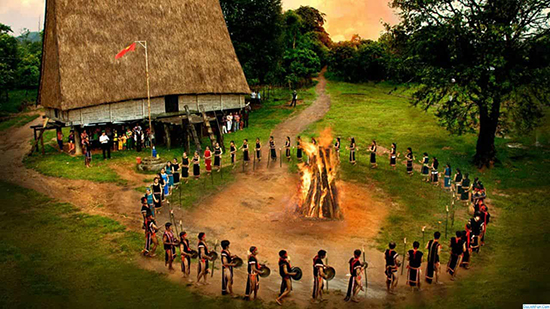
The Stieng people are an ethnic community with a long history in Vietnam and Cambodia. They speak Stieng, a language belonging to the Bahnaric branch of the Mon–Khmer language family. Their presence across both countries reflects longstanding connections in language, culture, and shared history.
Binh Phuoc – Home to the Largest Stieng Community in Vietnam
In Vietnam, the Stieng mainly live in Binh Phuoc Province, in the southeastern region. According to 2009 figures, around 81,708 Stieng people lived in the province.
Their traditional way of life has been closely connected with the land and natural environment of southeastern Vietnam. Over generations, language, customs, and community traditions have helped shape a distinct Stieng cultural identity.
A Community Spanning a Modern Border
Stieng communities are also found in Cambodia, where they are classified among the Khmer Loeu, a term historically used for non-Khmer communities living mainly in the country’s highland areas.
Their presence on both sides of the Vietnam–Cambodia border reflects a much older history of settlement in mainland Southeast Asia. Shared linguistic and cultural characteristics continue to connect Stieng communities, even though they now live within two different countries.
Language and Cultural Identity
The Stieng language is an important part of the community’s cultural identity. As a Bahnaric language, it is related to several other Mon–Khmer languages spoken by indigenous communities across Vietnam and Cambodia.
Like many ethnic communities today, the Stieng are experiencing changes brought by economic and social development. Yet maintaining their language, customs, and traditional values remains important to preserving their cultural identity.
From Binh Phuoc to Stieng communities in Cambodia, their story forms part of the rich cultural diversity of mainland Southeast Asia — a region where longstanding communities continue to preserve their distinctive heritage while adapting to a changing world.