
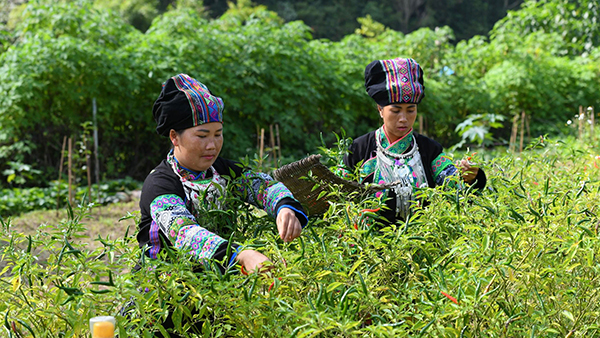
The Bouyei are a Tai-speaking ethnic community with a long history in southwestern China and a smaller presence in the mountainous northern regions of Vietnam. Known by several names, including Puyi, Buyei, and Buyi, they are officially recognized as one of China’s 56 ethnic groups. In Vietnam, the Bouyei number around 3,000 people, mainly living in Muong Khuong District of Lao Cai Province and Quan Ba District of Ha Giang Province. The Tu Di are one local group closely associated with the Bouyei community in Muong Khuong.
From Guizhou to the Northern Borderlands
The Bouyei cultural landscape stretches across several mountainous areas of southern China, particularly Guizhou, Yunnan, and parts of Sichuan. In Guizhou, large communities are concentrated in Qianxinan and Qiannan.
Their history is closely connected with fertile valleys and lowland areas where agriculture gradually shaped a settled way of life. Over different historical periods, social and economic changes encouraged some Bouyei communities to move southward, eventually contributing to their presence in the border regions of Vietnam today.
Despite living across different territories, Bouyei communities continue to share many cultural characteristics, including language, traditional customs, festivals, and beliefs.
Language as a Link Between Communities
The Bouyei language belongs to the Tai-Kadai language family and is closely related to Standard Zhuang. Bouyei dialects form part of a broader linguistic continuum, with variations from one locality to another.
In China, a written form of Bouyei was developed by linguists in the 1950s using the Latin alphabet, with conventions influenced by the Pinyin system. Beyond everyday communication, the language carries community memories, oral traditions, folk stories, and ways of understanding family, ancestors, and the natural world.
Although the Bouyei population in Vietnam is relatively small, their language and traditional cultural practices remain important elements of community identity.
An Agricultural Way of Life
Agriculture has long been at the heart of Bouyei life. Depending on the local environment, communities cultivate rice, millet, wheat, potatoes, maize, and other crops. Some areas are also known for tea cultivation, sericulture, and other agricultural activities suited to the surrounding landscape.
Traditional handicrafts are another important part of Bouyei culture. Weaving, textile production, and especially batik are well known for their distinctive patterns and craftsmanship.
Today, economic life is changing, and many Bouyei people are increasingly involved in trade and business. Even so, memories of agricultural life remain visible in traditional festivals, customs, and practices passed down through generations.
Festivals Honoring Farming and Ancestors
Traditional festivals hold an important place in Bouyei cultural life, often reflecting the community’s close relationship with agriculture, family, and ancestral memory.
One notable celebration is the Ox King’s Day, held on the eighth day of the fourth lunar month. The festival honors the ox, an animal that has traditionally played an essential role in farming, while also expressing hopes for favorable weather, good harvests, and a prosperous year.
The sixth day of the sixth lunar month is another important traditional occasion, associated with ancestor worship and the remembrance of figures preserved in Bouyei cultural memory.
Pangu and the Story of Ancestral Origins
One of the most distinctive elements of Bouyei oral tradition is the legend of Pangu, a figure associated with the creation of the world and the origins of the community.
According to the legend, Pangu created the world, learned how to cultivate rice, and married the daughter of the Dragon King. Their union gave rise to the Buyei people, and they had a son named Xinheng. The story continues through family conflicts, separation, and eventual reconciliation before Pangu dies on the sixth day of the sixth lunar month.
For this reason, the date is remembered not only as a time of commemoration but also as an occasion to retell stories of ancestral origins and strengthen connections between generations.
Keeping Cultural Values Alive
From language and handicrafts to traditional festivals and origin legends, Bouyei culture has been shaped by the close relationship between people, their environment, agricultural life, and collective memory. Although modern economic and social changes continue to transform everyday life, these traditions remain important expressions of Bouyei identity.
From Guizhou and Yunnan to the mountainous borderlands of northern Vietnam, the Bouyei cultural journey reflects the resilience of a Tai-speaking community that has adapted to different landscapes and historical periods while preserving distinctive traditions that continue to enrich life today.