
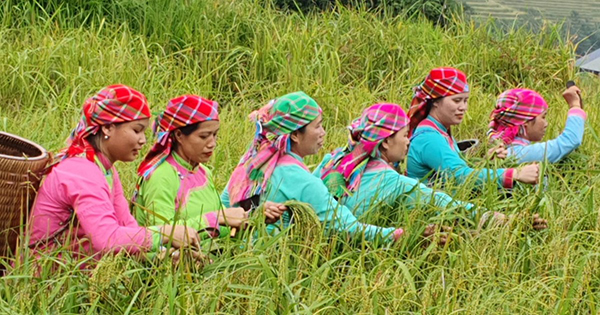
The Giay are one of the ethnic communities that have long lived in the mountainous regions of northern Vietnam. Most Giay people reside in the provinces of Lao Cai, Ha Giang, Lai Chau, and Cao Bang. According to the 2019 census, the Giay population numbered 67,858. From language and livelihoods to customs and spiritual traditions, Giay culture reflects a close relationship with nature and the village community.
Village Life Shaped by Agriculture
Wet-rice cultivation has long played an important role in Giay life. Valleys with reliable water sources are used for growing rice, while steeper areas may be planted with corn and cassava or used to provide feed for livestock.
Buffaloes are closely associated with agricultural work, particularly plowing and preparing the fields. Chickens and pigs are also commonly raised for household consumption and important family occasions.
In the past, farmland within Giay communities was often regarded as communal property. Today, individual families are more likely to manage their own plots, but the tradition of mutual support in agricultural work remains strong. Planting and harvesting often involve several members of the village, reflecting the sense of solidarity that has long been an important part of Giay community life.
Roong Pooc – Welcoming the New Rice Season
For the Giay, the beginning of a new agricultural season is more than a time to return to the fields. It is also marked by important community traditions. On the Snake Day of the first lunar month, the Giay celebrate Roong Pooc, a festival that marks the beginning of the new rice season.
The festival is an occasion to pray for favorable weather, abundant harvests, peace, and prosperity. It also brings villagers together through communal gatherings and traditional cultural activities.
Roong Pooc is therefore more than an agricultural festival. Over generations, it has become part of the community’s shared cultural memory, reflecting the Giay understanding of the close relationship between people, the land, and the agricultural cycle.
Traditional Dress and Distinctive Colors
Traditional Giay clothing is mainly made from cotton. Women commonly wear brightly colored five-panel blouses fastened on the right side, with contrasting collars and cuffs. Colorful headscarves add another distinctive element to women’s traditional appearance.
Traditionally, men wore simple tunics and turbans, while both men and women commonly wore loose indigo-dyed trousers. Today, modern clothing has become increasingly common, particularly among men. Nevertheless, traditional garments continue to appear during festivals and other cultural occasions.
Language and Folk Songs
The Giay speak a language belonging to the Tai language family and closely related to Bouyei. In modern life, Vietnamese has become increasingly important, particularly in education and communication with other communities.
Despite this change, the Giay language remains part of family and community life. It serves not only as a means of communication but also as a way of preserving stories, customs, and traditional knowledge passed down through generations.
Giay spiritual and cultural life is also expressed through traditional forms of folk singing, including Vuong and Phuon. These songs provide a way for people to express emotions, socialize, and preserve elements of their traditional performing arts.
Doong Xia – A Sacred Space in the Village
Traditional beliefs hold an important place in Giay spiritual life. Alongside ancestor worship, the Giay have traditionally believed in supernatural forces associated with the heavens, the earth, the household hearth, and other elements that influence human life.
One distinctive feature is Doong Xia, a sacred grove traditionally found within the village environment. The grove is protected by the community and regarded as a spiritual place associated with the deity believed to watch over and protect the village.
Twice a year, offerings are made at the largest tree in the grove to seek protection and blessings for the community. Maintaining these rituals also reflects a traditional respect for nature and an awareness of the importance of preserving sacred spaces.
Cultural Values Passed Down Through Generations
Modern life has brought many changes to the Giay community, influencing livelihoods, clothing, language, and family life. Yet many traditional values continue through festivals, folk songs, spiritual practices, and communal activities.
From rice fields nestled in mountain valleys to sacred groves within village communities, Giay culture has been shaped by a close connection with the land, agricultural seasons, nature, and community life. These enduring values give the Giay a distinctive cultural identity and contribute to the rich diversity of ethnic cultures in northern Vietnam.