
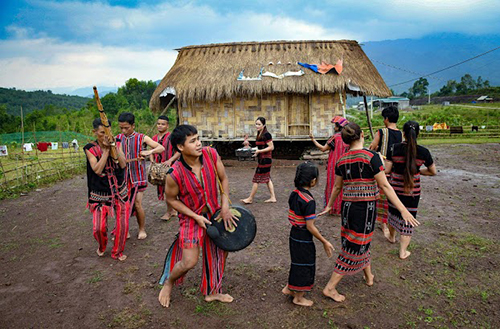
The Ta Oi are an ethnic community living on both sides of the Vietnam–Laos border. In Vietnam, they numbered 52,356 people in 2019 and are mainly found in A Luoi District of Thua Thien Hue and Huong Hoa District of Quang Tri. Across the border in Laos, the community is concentrated around Ta Oy in Salavan Province. The Ta Oi language belongs to the Mon–Khmer language family. The community is also known by names such as Taoih and Ta Uot, while the Pa Co subgroup uses names meaning “people of the highlands.”
Communities Shaped by Different Landscapes
The Ta Oi are traditionally divided into several local groups, including Ta Uot, Pa Co, and Ba Hi, each associated with a different living environment.
The Ta Uot mainly inhabit middle-altitude and sparsely settled mountain areas, where shifting cultivation has long been important. Cotton growing, weaving, and brocade making are closely connected with their traditional way of life. The Pa Co tend to live in foothills and hilly areas, practicing cultivation on sloping fields while making extensive use of bamboo and rattan. They have also engaged in trade, exchanging textiles, clothing, blacksmith products, shoulder baskets, and forest goods such as honey. The Ba Hi, who live closer to lowland valleys, have traditionally combined trade with wet-rice cultivation.
Weaving, Brocade, and Handcrafted Traditions
Textile making is an important part of Ta Oi material culture. Cotton is spun and woven into cloth, which may then be decorated with brocade patterns and glass beads. These techniques are especially associated with the Ta Uot and reflect both practical skills and aesthetic traditions passed down through generations.
Among the Pa Co, bamboo and rattan are particularly important materials. Baskets and other woven objects are closely connected with everyday life, farming, and trade. Traditional musical instruments, including drums and pan flutes, also contribute to the cultural soundscape of Ta Oi communities.
A Spiritual World Rooted in Nature
Ta Oi traditional beliefs are strongly connected with animism and the idea that spirits inhabit the natural world and important spaces of daily life. Human souls are also believed to have a spiritual existence beyond physical life, while dreams and rituals may be understood as ways of communicating with the unseen world.
Among the spirits are giang dak, the water spirit imagined as a short old man with white hair and beard, and giang an teng, the spirit associated with the household. Long houses have their own protective spirit, while the tiger spirit, giang avo, is regarded as a guardian of the forest.
In Laos, another traditional belief is associated with nang, a form of “love medicine” made from resin connected with the Ko-tach bird. Such beliefs reveal how closely Ta Oi spiritual life has historically been intertwined with forests, rivers, houses, and the wider landscape.
A Cultural World Across the Truong Son
From mountain fields and woven textiles to forest spirits and traditional trade, Ta Oi culture reflects a close relationship between people and the landscapes they inhabit. Although the community is divided by the modern Vietnam–Laos border, many cultural traditions continue to tell a broader story of life across the Truong Son mountain range.