
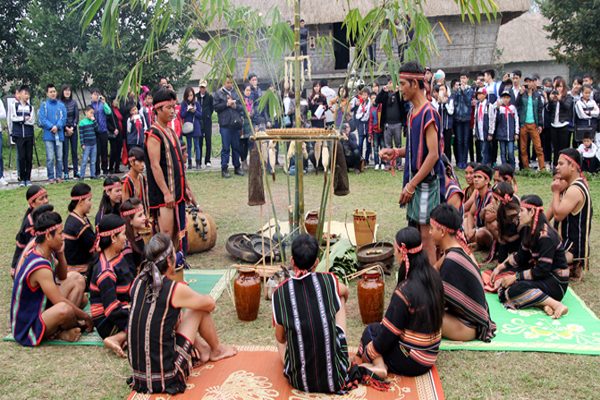
Amid the majestic mountains and forests of Vietnam’s Central Highlands, the Jarai people are one of the region’s indigenous communities with a long history and rich cultural identity. They mainly live in Gia Lai, Kon Tum, and parts of Dak Lak, with Jarai communities also found in Ratanakiri, Cambodia. Their culture is reflected in village life, matrilineal traditions, folk beliefs, gong music, and traditional ceremonies.
History and Origins
The history of the Jarai people is closely connected to the Central Highlands and the Truong Son mountain range, a long-standing home to many indigenous communities in mainland Southeast Asia. Over generations, the Jarai have interacted with neighboring groups, including the Cham, Ede, and Khmer, contributing to the diversity of their culture and way of life.
The Jarai language belongs to the Malayo-Polynesian language group and is related to Cham and Ede. Despite many historical changes, the community has preserved numerous traditional customs and cultural values.
Villages and Community Life
The village is at the heart of traditional Jarai social life. Houses are commonly built from materials such as bamboo, wood, and leaves, creating a living space closely connected to nature. Communal activities, ceremonies, festivals, and cultural gatherings often take place within the village.
Community solidarity is an important value in Jarai society. People work together and participate in shared activities, while gong performances, traditional dances, and communal drinking of rice wine help strengthen relationships among villagers.
Matrilineal Traditions and Marriage
Matrilineal tradition is a distinctive feature of traditional Jarai society. Family lineage is traced through the mother, and after marriage, the husband traditionally moves to live with his wife’s family.
Women play an important role in family and kinship relationships. Although modern life has brought many changes, elements of the traditional matrilineal system can still be found in Jarai communities today.
Beliefs and the Spiritual World
Traditional Jarai beliefs are closely connected to nature. The community has traditionally believed that natural elements possess spiritual forces, and various rituals are performed to pray for health, good harvests, and peaceful lives.
In Jarai legends, the Kings of Fire, Water, and Wind are important figures representing the close relationship between people and the natural world. Alongside traditional beliefs, some Jarai communities today also practice religions such as Christianity.
Gong Music and Traditional Instruments
Music plays an important role in Jarai cultural life. Gongs are commonly performed during festivals, rituals, and important community events.
The Jarai also have a variety of traditional instruments, including the t’rung, k’ni, and other string and folk instruments. Music is more than entertainment; it is also a way of preserving stories, emotions, and life experiences passed down from one generation to another.
Festivals and Rice Wine
Traditional rice wine is an important part of festivals and community gatherings. People often gather together to share drinks, talk, sing, and dance in a lively and welcoming atmosphere.
Traditional festivals provide opportunities for community members to meet, strengthen their bonds, and pass cultural values on to younger generations.
Funeral Traditions and the Abandoning-the-Grave Ceremony
Funeral customs hold an important place in Jarai spiritual life. The deceased are traditionally buried in tomb areas decorated with wooden posts and carved statues featuring distinctive designs.
After a period of mourning, the family may hold the Abandoning-the-Grave ceremony, known as bo ma, which marks the final farewell to the deceased. After this ceremony, the living are considered to have completed their relationship with the dead and are free to continue their lives.
Jarai Culture Through Time
The Jarai people have preserved a rich cultural heritage characterized by matrilineal traditions, folk beliefs, gong music, and funeral rituals such as the Abandoning-the-Grave ceremony. Although modern life has brought significant changes, the community continues to preserve and pass on its traditional values, contributing to the rich and diverse cultural heritage of Vietnam’s Central Highlands.