
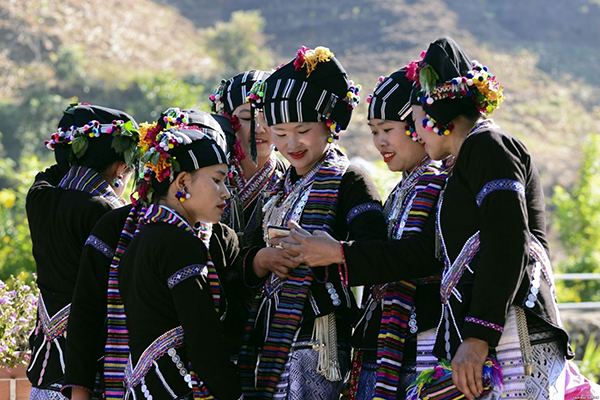
The Tai Lü are one of the ethnic communities belonging to the Tai language family, with populations found across several countries in Southeast Asia, including Vietnam, China, Laos, Thailand, and Myanmar. Their language belongs to the Southwestern Tai branch.
In Vietnam, the Tai Lü are concentrated mainly in Lai Chau Province. According to the 2009 census, their population numbered 5,601. Although relatively small in number, the Tai Lü have preserved a distinctive cultural identity shaped by their long history of settlement, interaction with other Tai communities, and a spiritual life strongly influenced by Theravada Buddhism.
Muong Thanh in the Historical Memory of the Tai Lü
One of the places closely associated with Tai Lü history is Muong Thanh, known as Muong Theng in the Tai Lü language. The area once held an important position within the historical and cultural landscape of Tai communities in northwestern Vietnam.
According to local traditions, the Tai Lü once built and controlled the Tam Van fortress in Muong Thanh and remained there for 19 generations before Hoang Cong Chat, a Thai leader, arrived and took control of the area.
These stories of Muong Thanh preserve more than memories of territorial history. They also reflect an important chapter in the long process through which Tai Lü communities established themselves in the northwestern region.
From Lai Chau to a Wider Tai Cultural World
Tai Lü cultural space extends far beyond Vietnam. Tai Lü communities also live in China, Laos, Thailand, and Myanmar, where they are known by different names depending on the country.
In China, the Tai Lü are officially classified within the Dai ethnic group. In Thailand, they are commonly known as Thai Lue and are mainly found in northern provinces such as Nan, Chiang Rai, Phayao, and Chiang Mai.
This wide distribution reflects the long-standing connections among Tai communities across mainland Southeast Asia. Despite historical and geographical changes, similarities in language, customs, and folk traditions continue to link these communities together.
Language and Folk Traditions
Tai Lü belongs to the Southwestern Tai language group and is closely related to several other Tai languages. The community’s name appears in different forms in international sources, including Tai Lue, Dai Lue, and Dai Le.
Folk music is an important part of Tai Lü cultural life. In Thailand, Tai Lue communities preserve khap lue, a traditional form of singing often accompanied by folk instruments, including pi mae, a traditional bamboo wind instrument.
These artistic traditions serve not only as forms of entertainment but also as ways of expressing emotions, telling stories, and passing collective memories from one generation to another.
Family Traditions and Community Life
The Tai Lü maintain a number of customs related to family and lineage. Traditionally, people inherit their father’s surname, while middle names may distinguish between men and women. Men commonly use Ba, while women use Y, as middle names.
These naming practices form part of the community’s traditional identity and reflect the importance of family and lineage in Tai Lü social life.
Through long-term interaction with neighboring Tai communities, Tai Lü culture has also absorbed various outside influences while retaining its own distinctive characteristics. This has created an identity that is both closely connected to the wider Tai cultural world and uniquely Tai Lü.
Theravada Buddhism in Spiritual Life
Theravada Buddhism plays an important role in the spiritual life of the Tai Lü. The religion has influenced many aspects of community life and contributed to the development of traditional customs and religious practices.
The presence of Theravada Buddhism is also one of the distinctive features of Tai Lü culture in Vietnam. It sets the community apart within the diverse religious landscape of the northwest, where different indigenous beliefs and religious traditions have interacted over time.
A Distinctive Cultural Presence in Northwestern Vietnam
Today, most Tai Lü people in Vietnam continue to live in Lai Chau, where mountain villages remain important spaces for maintaining traditional cultural values.
From the historical memory of Muong Thanh and the Tai Lü language to folk arts, family traditions, and Theravada Buddhist practices, Tai Lü culture has developed through layers of history and community experience.
Although relatively small in population, the Tai Lü contribute a distinctive cultural character to the rich and diverse heritage of northwestern Vietnam.