
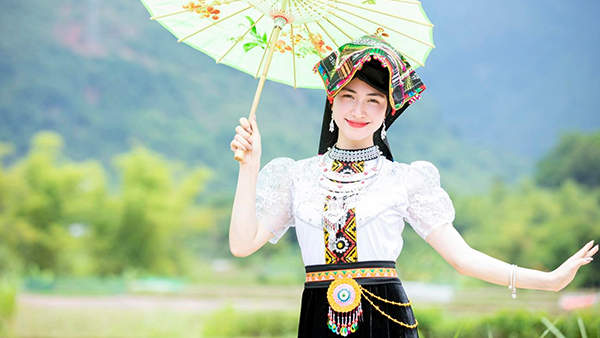
The Thai are one of Vietnam’s 54 officially recognized ethnic groups and have long been closely associated with the valleys and mountains of the country’s Northwest. With a population of more than one million, the Thai have developed a diverse cultural heritage shaped by migration, community life, agriculture, and centuries of interaction with neighboring peoples.
Today, the Thai are mainly concentrated in provinces such as Son La, Dien Bien, Lai Chau, Hoa Binh, and parts of northern and north-central Vietnam. Within the broader Thai community are several distinct groups, including the Black Thai, White Thai, and Red Thai, each with its own cultural characteristics.
From Yunnan to the Valleys of Northwestern Vietnam
Historical traditions and local accounts suggest that Thai communities gradually migrated southward from areas of present-day Yunnan in China between the 7th and 13th centuries. Over time, they settled in the fertile valleys of what is now Northwestern Vietnam, establishing villages and political communities known as muong.
One of the most important historical centers was Muong Thanh in present-day Dien Bien. According to Thai traditions, the region was associated with Khun Borom, a legendary ancestor regarded as an important figure in the history of several Tai-speaking peoples. By around the 11th century, Thai communities had established organized political centers in parts of the Northwest, laying the foundations for a distinctive social and cultural system.
Muong and Ban: The Foundations of Thai Community Life
Traditional Thai society was organized around two important levels of community: the ban, or village, and the muong, a larger territorial and political unit. Villages were often built in fertile valleys near rivers and streams, where the land was suitable for wet-rice cultivation.
Rice farming became the economic foundation of Thai life and influenced many aspects of their culture. Houses, customs, festivals, and community relationships all developed around the agricultural cycle. Over time, numerous Thai communities became part of the historical region known as Sip Song Chau Tai, a network of Thai-speaking territories across parts of present-day Vietnam and Laos.
Historical Changes in the Northwestern Highlands
The history of the Thai communities has also been shaped by major political changes. During the Nguyen dynasty, administrative arrangements were introduced in the Northwest, including the establishment of an official position in Dien Bien Phu in 1841.
In the late 19th century, French colonial expansion brought further changes. In 1889, the French concluded an agreement with Deo Van Tri, a prominent local Tai leader, strengthening French influence over the region while leaving certain traditional structures in place.
The Northwest later became an important area during the First Indochina War. The Battle of Dien Bien Phu in 1954 marked a major turning point in Vietnamese history and brought profound political and social changes to the region. Thai communities, like other ethnic groups in the Northwest, experienced significant transformations in the decades that followed.
Three Major Cultural Expressions of the Thai
Although they share many common traditions, Thai communities in Vietnam are not culturally uniform. The Black Thai, White Thai, and Red Thai are among the best-known groups.
The Black Thai are particularly associated with Son La, Dien Bien, and parts of Lai Chau, while the White Thai are found mainly in areas of Lai Chau, Dien Bien, and Hoa Binh. Red Thai communities are concentrated in parts of the north-central region and neighboring areas.
Beyond these major groups, Vietnam is also home to other Tai-related communities, including the Phu Thai, Tay Thanh, Thai Yo, and Tay Da Bac. Differences in language, clothing, customs, and local traditions contribute to the remarkable diversity of Thai culture across Vietnam.
A Culture Shaped by Mountain Valleys
For generations, the Thai have maintained a way of life closely connected to the natural environment. Their villages are often situated along rivers and in fertile valleys, while traditional houses are adapted to the local landscape and climate.
According to the 1999 census, the Thai population in Vietnam exceeded 1.3 million, with particularly large communities in Son La, Thanh Hoa, Nghe An, Lai Chau, Dien Bien, Hoa Binh, and Ha Tinh.
Today, modernization has brought many changes to Thai communities, but traditional languages, customs, festivals, architecture, and agricultural knowledge remain important elements of their cultural identity. The diversity found among Thai groups demonstrates that their heritage is not a single, uniform tradition, but a collection of local identities shaped by history and the landscapes of Vietnam’s mountains and valleys.